
Handing over a massive upfront deposit before seeing a single live concept is the single biggest mistake when hiring a website designer in Australia. If you feel uneasy about locking yourself into a rigid contract with an agency that might disappear for weeks or bill you for basic revisions, you aren't alone. You need a clean, high-performing build that drives genuine enquiries, not confusing technical jargon or bloated multi-page setups your business doesn't require.
True accountability means reviewing real progress before parting with your hard-earned cash. You deserve total ownership of your digital assets and an honest partner who prioritises speed and conversions over billable hours. In this guide, you'll discover the practical truth about hiring a website designer in Australia so you can sidestep typical agency traps, hidden maintenance fees, and overpriced lock-in contracts. We bust the five most expensive industry myths and give you an objective framework to evaluate designers with complete confidence.
Key Takeaways
- Learn why conversion-focused layouts matter far more than visual flair alone when turning visitors into paying customers.
- Discover the real structural differences between agencies, marketplaces, and hiring a dedicated website designer to avoid paying for bloated overheads.
- Understand why hefty upfront deposits shift all project risk onto your business, and how approval-first payment models keep contractors accountable.
- Identify whether your commercial goals require a lean one-page setup, a functional shopfront, or custom development before committing to unnecessary pages.
- Spot the critical red flags in design proposals early, from closed proprietary platforms to hidden post-launch maintenance clauses.
What Does a Modern Website Designer Actually Do for Your Business?
A commercial website designer does one core job: build a digital asset that turns curious visitors into paying customers. That sounds straightforward, but many agencies cloud the process with months of vague discovery workshops and unnecessary visual fluff. In reality, modern web design encompasses user interface engineering, technical performance, and conversion architecture.
A true professional builds for function first. Amateurs grab an off-the-shelf template, drop in stock photos, and call it a day. A specialist designs the exact path a prospect takes from landing on the page to making an enquiry. Every element serves a clear commercial purpose:
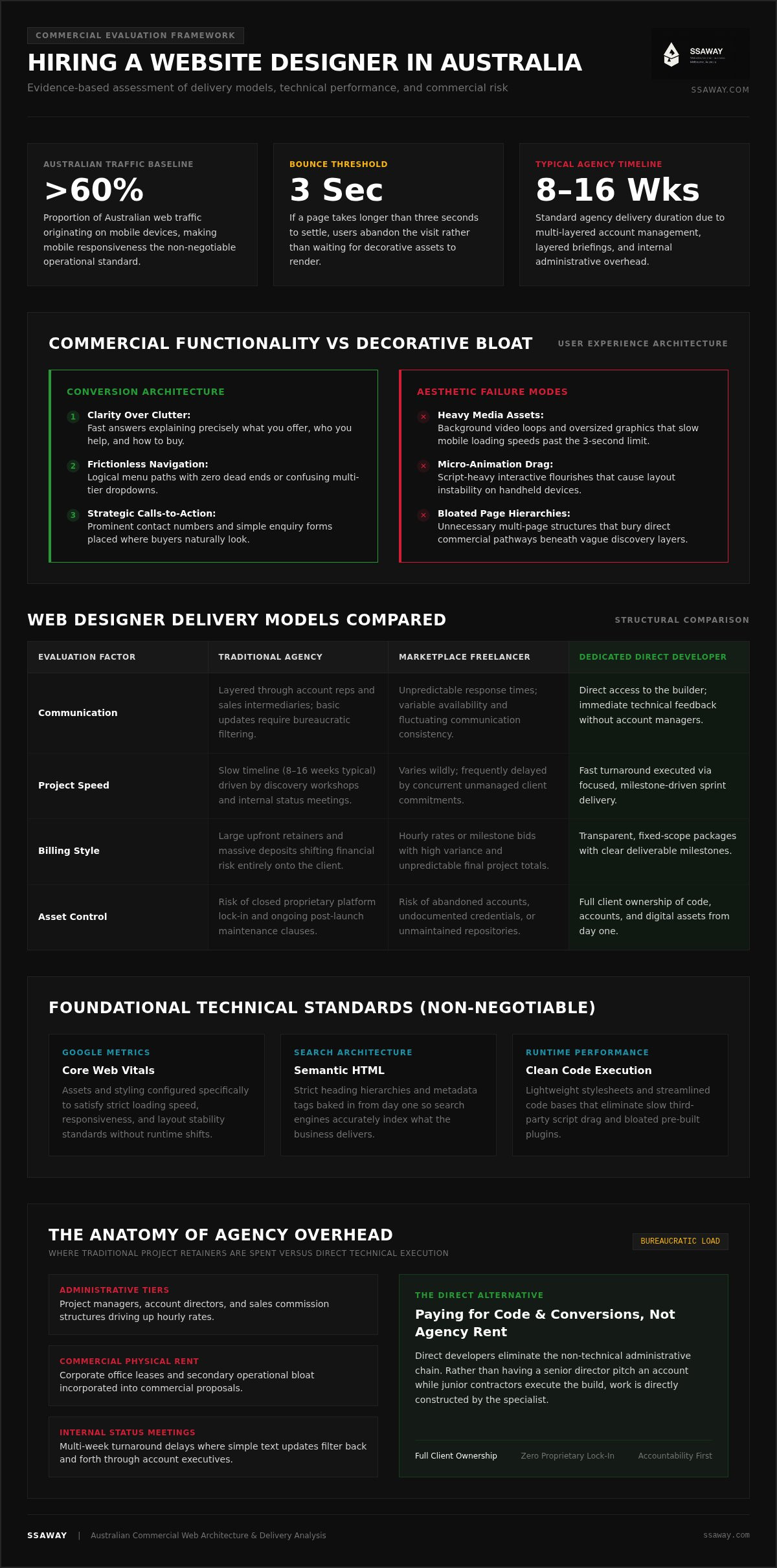
- Clarity over clutter: Fast answers explaining what you offer, who you help, and how to buy.
- Frictionless navigation: Logical menu paths with zero dead ends or confusing multi-tier dropdowns.
- Strategic calls-to-action: Visible phone numbers and simple enquiry forms placed right where buyers look.
Aesthetics vs Functionality: Why Pretty Sites Can Still Fail
A website can look visually striking and still completely fail your bottom line. Heavy background videos, slow micro-animations, and oversized graphics might look impressive in a boardroom presentation. On a prospective customer's phone, they simply create lag.
If a page takes longer than three seconds to settle, users leave. They don't stick around to admire decorative artwork; they want immediate answers. High-performing design eliminates visual clutter. It prioritises crisp typography, lightning-fast readability, and intuitive button placement so your customers reach checkout or your contact form without friction.
The Technical Stack: Mobile Performance and On-Page SEO
With more than 60% of Australian web traffic originating on mobile devices, mobile responsiveness is your operational baseline. A skilled website designer builds for handheld screens from the very first line of code, ensuring touch targets are easy to tap and layouts scale cleanly without horizontal scrolling.
Search engines reward speed and structure. Professional development bakes technical SEO directly into the foundation rather than treating it as an afterthought:
- Core Web Vitals: Optimised assets and lean styling configured to pass Google's strict loading and layout stability metrics.
- Semantic HTML: Correct heading hierarchies and metadata tags that tell search engines precisely what your business delivers.
- Clean code execution: Lightweight stylesheets that eliminate bloated plugins and third-party script drag.
When these technical standards are locked in from day one, your site ranks better, loads instantly, and delivers a seamless buying experience across every device.
Evaluating Web Designers: Agency vs Freelancer vs Direct Developer
Selecting the right website designer often comes down to choosing between three delivery models: a traditional agency, an unvetted marketplace freelancer, or a direct developer. Each path impacts your timeline, budget, and eventual control over your digital assets.
| Factor | Traditional Agency | Marketplace Freelancer | Dedicated Direct Developer |
|---|---|---|---|
| Communication | Layered through account reps | Unpredictable response times | Direct access to the builder |
| Project Speed | Slow (8–16 weeks typical) | Varies wildly (often delayed) | Fast (focused sprint delivery) |
| Billing Style | Large upfront retainers | Hourly or milestone bids | Transparent, fixed-scope packages |
| Asset Control | Risk of proprietary platform lock-in | Risk of abandoned accounts | Full client ownership from day one |
The Hidden Overheads Inside Big Agency Invoices
Traditional agencies carry heavy commercial rent, sales commissions, and administrative tiers. When you receive a hefty project proposal, a large portion of that bill covers project managers, internal status meetings, and operational bloat rather than code.
Senior directors often pitch your account, but junior contractors or interns carry out the daily design work. Each basic edit filters through an account executive, turning simple text updates into multi-week revisions. You pay agency rates for bureaucratic friction.
The Real Risks of Unvetted Marketplace Freelancers
Hiring an anonymous operator from a gig bidding site introduces severe operational vulnerabilities. Many rely on clunky third-party page builders that break during updates or bloat your database.
Ghosting remains an active hazard. If a freelancer abandons your build halfway through, recovering your domain access or staging code can prove difficult. Under the Australian Consumer Law, you have statutory remedies when services are not delivered, but enforcing those rights against offshore or anonymous sellers is often near impossible.
Direct Development: Achieving Professional Speed Without Agency Bloat
Working directly with a dedicated developer strips out the middlemen. Your requirements go straight to the person writing the code and structuring your sales funnel. Project turnarounds drop from months to days because you skip the internal agency bureaucracy.
Review our comprehensive guide on affordable website design to see how lean development structures protect your capital. If you want a clear build without corporate runarounds, exploring streamlined services through ssaway.com gives you direct access to skilled developers focused solely on conversions.
Busting the Upfront Deposit Myth: Why Paying in Advance Is Risky
Across Australia, demanding a 30% to 50% upfront deposit has become the default standard for creative agencies. Most firms treat this advance payment as non-negotiable. For the business owner, it introduces immediate financial exposure. The moment that deposit clears, the operational power balance shifts entirely away from you.
You assume all the risk upfront. The contractor holds your capital while you wait weeks just to see initial concepts. If the execution falls short, getting that money back is an uphill battle.
The Psychology of the Upfront Retainer
Why do conventional firms demand advance payments? They rely on upfront cash flow to cover sales commissions, executive salaries, and administrative overhead. Paying upfront commits you to their pipeline before they demonstrate real technical capability.
Once your funds clear, project urgency often evaporates. When an initial layout misses the mark, you enter the classic sunk cost trap. Do you walk away and swallow the loss, or endure endless revision cycles that delay your commercial launch? Disagreements over revision limits frequently morph into scope disputes, leaving business owners with stalled projects and depleted cash reserves.
How the Approval-First Framework Protects Small Business Cash Flow
There is a far fairer way to hire a professional website designer. An approval-first framework reverses the traditional agency transaction. Instead of paying in advance, the developer builds your site first. You inspect the fully functional build on a staging environment and only pay once you are completely satisfied.
This structure changes everything:
- Interactive testing: You test live buttons, forms, and mobile layouts instead of guessing from flat image mock-ups.
- Zero financial exposure: Your working capital remains untouched until you see concrete proof of delivery.
- Aligned incentives: The builder stays focused on speed, clean code, and practical usability to earn your sign-off.
A website designer who operates without upfront deposits backs their own skill. It eliminates financial gambles, protects your balance sheet, and guarantees you only fund an asset that works for your business.
Matching Website Scope to Your Commercial Goals
Before hiring a website designer, define what your site actually needs to achieve. Many agencies push sprawling twenty-page architectures simply to inflate project scope. Keep your commercial footprint disciplined by working through a practical selection process:
- Define the conversion goal: Identify whether success means inbound phone calls, detailed quote requests, or immediate product sales.
- Select lean architecture: Match your page structure directly to that single objective without adding fluff pages.
- Audit existing assets: Bring your current logos and imagery to the table so you don't pay for redundant design hours.
- Demand asset ownership: Ensure your domain, hosting, and source files remain under your direct control from launch day.
One-Page vs Shopfront: Picking the Right Engine for Your Trade
For trades, local service contractors, and solo operators, a single high-impact page often converts significantly higher than an expansive site. Everything sits in a logical, continuous scroll. No lost visitors. No unnecessary clicks. Review our breakdown of one-page website packages to see how streamlined layouts drive faster buying decisions.
When does your business outgrow a single page? Move to a multi-page shopfront website package only when you offer distinct, high-margin service categories that require individual search targeting or dedicated case studies.
E-Commerce Without the Enterprise Price Tag
Selling online doesn't require tens of thousands in complex custom software. Modern e-commerce website packages give growing merchants everything essential straight out of the box: real-time inventory management, automated order notifications, and secure payment processing via Stripe or PayPal.
A fast, functional online store lets you test commercial demand immediately. Avoid bespoke web development unless your operations genuinely require complex third-party software integrations.
Separating Website Development from Unnecessary Branding Packages
A common agency tactic is insisting that web development cannot proceed without an expensive corporate rebrand. This is false. If you have an established logo, consistent colours, and working vehicle signage, your site should build directly around those existing assets.
Never pay a website designer to reinvent your visual identity when your immediate priority is generating customer enquiries. Focus your capital strictly on code speed and conversion paths. If you are ready to launch without agency bloat, explore streamlined builds at ssaway.com to get a high-performing site built around your specific business goals.
Checklist for Hiring a Web Designer: Red Flags and Green Lights
Evaluating a prospective website designer requires looking past polished sales decks. Focus on contractual terms, code independence, and real accountability. Use this practical vetting checklist before signing any proposal:
- Red Flag: Upfront deposit demands. Handing over 30% to 50% before seeing functioning builds shifts all project risk onto your business.
- Red Flag: Proprietary platform lock-in. Agencies building on closed, in-house systems prevent you from ever changing hosting providers without starting from scratch.
- Red Flag: Open-ended hourly billing. Vague time estimates with uncapped revision fees turn minor adjustments into unexpected invoices.
- Green Light: Fixed-price scope agreements. Clear, all-inclusive packages that guarantee the total investment upfront.
- Green Light: Integrated SEO and mobile optimisation. Technical speed and search fundamentals built directly into the site structure as standard.
- Green Light: Complete asset handover. Full administrative ownership of your code, database, and domain records transferred upon sign-off.
Essential Contract Terms: Ownership, Hosting, and Portability
Your contract must state unequivocally that you own every design asset and line of code once final approval takes place. Avoid agencies that register your domain under their own master account or lock databases behind proprietary hosting environments.
If you choose to move providers later, your site must remain completely portable. Demand open web standards, independent hosting access, and full administrative rights from day one.
The SSAWAY Way: Total Transparency and Zero Upfront Risk
Eliminating traditional agency barriers is the foundation of the SSAWAY approach. Delivering nationwide across Australia, SSAWAY operates on an approval-first standard designed around client protection. Whether your business requires a one-page setup, a functional shopfront package, e-commerce, or custom development, project costs remain fixed and predictable.
There are zero upfront payments required to start work. A professional website designer builds your site, configures integrated SEO, and delivers an interactive build for your inspection. You test the live site, confirm every feature works, and pay only after complete review and approval. It is a straightforward, transparent model that keeps the developer accountable and your cash flow protected.
Take Control of Your Next Digital Build
Securing a high-performing online presence doesn't require handing over half your capital in blind faith. By focusing on conversion architecture rather than bloated page counts, you protect your cash flow and ensure your digital assets generate measurable commercial returns. Demanding total ownership of your source code and hosting records keeps your business entirely independent.
Partnering with a reliable website designer should feel straightforward, collaborative, and fair. Back your business with fixed-price packages that include integrated search engine optimisation, mobile-first performance, and nationwide delivery without locking you into expensive retainers. Most importantly, insist on an approval-first process where you inspect the finished build before paying a single cent. Ready to remove the financial risk from your project? Explore fixed-price web design with zero upfront payment and launch your new site with absolute peace of mind.
Frequently Asked Questions
How much does it typically cost to hire a website designer in Australia?
Rates vary significantly depending on whether you engage a bloated traditional agency or a streamlined direct developer. Traditional agencies bundle account management and discovery meetings into hefty project quotes, whereas unvetted freelancers bill uncertain hourly rates. A modern, transparent website designer offers fixed-price packages based on exact scope, giving you complete cost certainty without unexpected revision invoices or scope creep.
Do I need to pay a deposit before a web designer starts work?
While traditional design agencies routinely demand a thirty to fifty percent deposit in advance, you don't have to accept that financial exposure. Forward-thinking developers operate on an approval-first model with zero upfront payment. You review and test the completed, functional build on a staging server first. You only transfer funds once you are completely satisfied with the live site.
What is the difference between a one-page website and a full shopfront?
A one-page website consolidates your core services, proof points, and contact form into a single, high-converting scroll. It works exceptionally well for local trades and specialised contractors. A shopfront website package expands that setup into multiple dedicated pages. This multi-page structure suits established operations that provide diverse service categories requiring separate search engine indexing and distinct case study galleries.
Will my website designer handle search engine optimisation as well?
A qualified website designer builds foundational technical SEO straight into the code. This includes semantic heading hierarchies, fast-loading mobile layouts, and proper meta descriptions. Be cautious of providers who treat basic indexing and speed optimisation as expensive optional add-ons. Quality builds integrate these technical standards on launch day so search engines can read and rank your content immediately.
Who owns my website and domain once the project is finished?
You should always retain total ownership of your domain registration, database, and source files. Some traditional agencies register assets under their own corporate accounts, effectively holding your online presence hostage. Always verify that your agreement guarantees full administrative handover upon project completion, ensuring you can transfer hosting or make structural changes whenever you choose without penalty.
How long does a professional website design project take from start to finish?
Turnaround times depend entirely on the operational structure of your provider. Traditional creative agencies often take between eight and sixteen weeks due to internal bureaucratic review chains and multiple discovery meetings. In contrast, working directly with a dedicated developer typically delivers a complete, review-ready build within one to two weeks, allowing you to begin generating customer enquiries much faster.
Can I update the content on my website myself after it launches?
Yes, professional builds are deployed on accessible content management systems that allow you to update operating hours, service descriptions, and contact details with ease. You shouldn't have to pay a recurring maintenance retainer simply to edit basic text or publish fresh announcements. Your developer should provide straightforward administrative access so you maintain complete autonomy over your site.


