
A higher web design price does not guarantee a superior website. It often just subsidises an agency's bloated overheads. If you have requested quotes across Australia recently, you know the frustration firsthand. One provider pitches a standard build for the cost of a new car, while another offers pocket change for the exact same brief. Add dense technical jargon, surprise maintenance fees, and demands for massive upfront deposits, and commissioning a site feels like a high-stakes gamble.
You shouldn't have to carry the financial risk just to get your business online. This guide breaks down how to evaluate quotes with confidence, spot hidden contract traps, and secure quality development without handing over cash before seeing the finished product. We will examine the core factors driving development costs, share a straightforward method to compare agency proposals without technical confusion, and explain how a strict pay-on-approval model keeps you in complete control from start to finish.
Key Takeaways
- Understanding what genuinely shapes a web design price helps you separate essential technical deliverables from inflated agency overheads.
- Choosing fixed-price packages over open-ended hourly billing locks in your project budget and protects you from surprise scope creep.
- Uncovering hidden recurring fees, such as marked-up hosting and mandatory maintenance retainers, prevents long-term contract lock-in.
- Selecting the right build type, from streamlined one-page packages to complete digital storefronts, ensures you never pay for unnecessary digital bloat.
- Opting for an approval-first development model eliminates financial risk by letting you review and approve the finished site before paying a cent.
What Factors Actually Determine a Web Design Price?
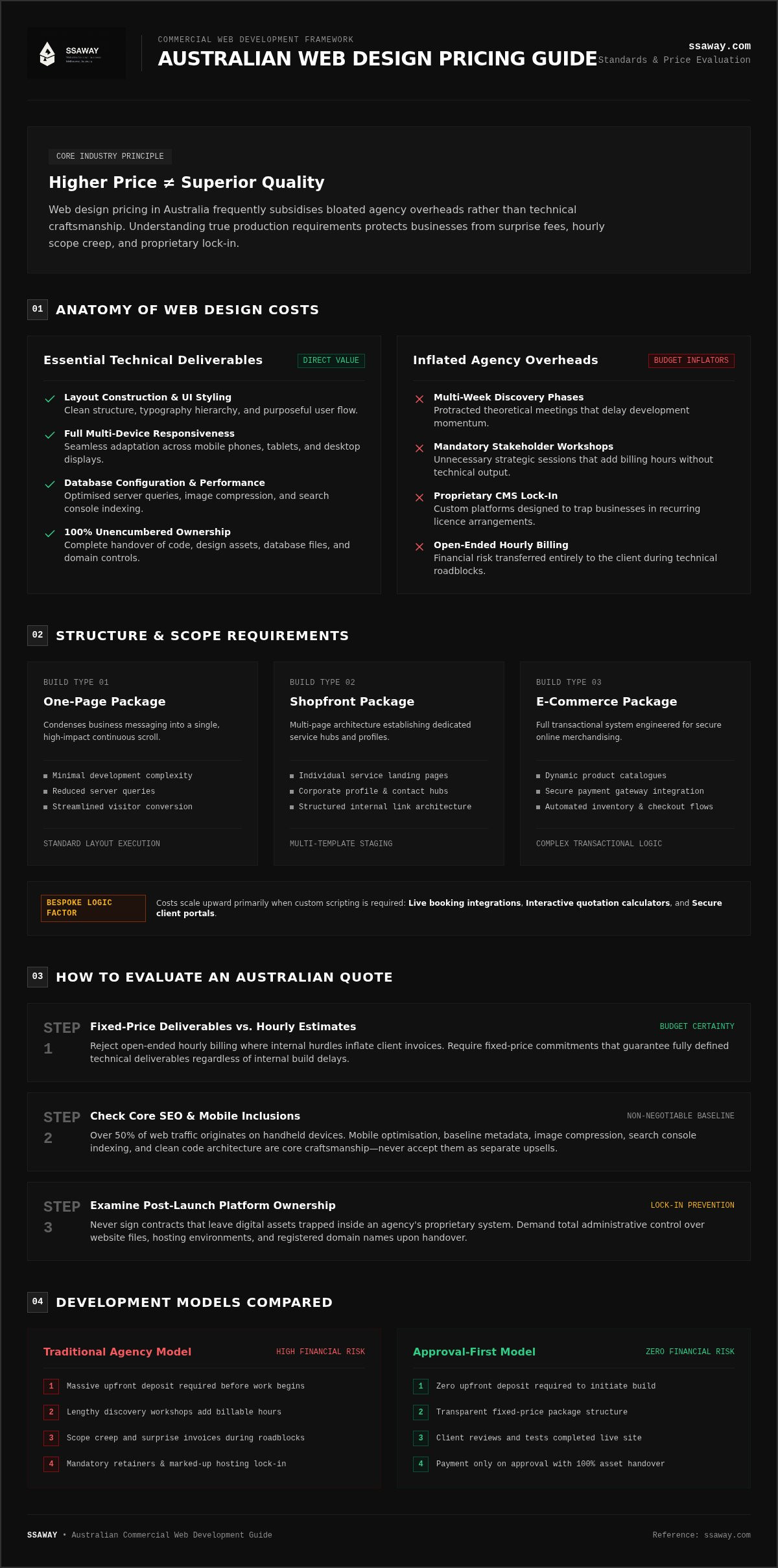
Website quotes are not drawn from thin air, though agencies often make it feel that way. A commercial web design price simply reflects structure, technical complexity, and the developer hours required to build the asset. Traditional agencies frequently cloud these basic mechanics behind talk of stakeholder workshops, multi-week discovery phases, and mandatory branding exercises. In reality, understanding what web design entails comes down to tangible technical deliverables. You are paying for layout construction, user interface styling, database configuration, and responsiveness across modern devices.
Beyond raw coding, real digital ownership shapes overall value. When you commission a build, you must own the finished digital property entirely. Unscrupulous providers use proprietary content systems to trap businesses in perpetual licensing arrangements. A fair quotation guarantees unencumbered ownership of your code, assets, and design files upon final handover.
Structure and Page Count Requirements
Page volume directly dictates production hours. Simple projects demand fewer templates, while complex directories require extensive staging:
- One-page website packages: Single-page layouts condense messaging into a continuous scroll. They minimise development complexity, reduce server queries, and convert visitors efficiently without extra navigation logic.
- Shopfront website packages: Multi-page platforms establish individual service landing pages, contact hubs, and dedicated corporate profiles. Each page requires unique formatting, asset placement, and internal link architecture.
- E-commerce website packages: Selling online introduces product catalogues, transactional databases, and payment gateway staging. Developers must build secure checkout flows, configure automated inventory updates, and test purchase sequences under various user scenarios.
Custom Functionality Versus Standard Layouts
Standard architectural patterns accelerate delivery. Using proven user-interface structures allows developers to craft functional, responsive websites rapidly without reinventing navigation basics. The web design price scales upward only when you demand bespoke logic.
Features like live booking integrations, interactive quotation calculators, and secure client portals require extensive backend scripting. Each bespoke tool demands custom database queries, cross-browser debugging, and rigorous security checks. Assess whether your business genuinely requires custom code today, or if standard functional templates deliver the exact same outcome without the bloated price tag.
How to Evaluate an Australian Web Design Quote
Comparing agency proposals requires a methodical audit rather than gut feeling. You need to look past glossy presentations and interrogate contract terms directly. Peak bodies like the Australian Web Industry Association advocate for clear operational standards, yet quoting discrepancies remain rampant across the country. A structured review confirms whether an agency's web design price represents genuine value or an open invitation to budget blowouts.
Step 1: Fixed-Price Deliverables Versus Hourly Estimates
Hourly billing creates misaligned incentives. When a developer encounters unexpected technical hurdles, you carry the financial burden through inflated invoices. Fixed-price agreements eliminate this friction completely. The agency commits to delivering defined technical functionality regardless of internal build delays. Review our parent guide on affordable website design for foundational budgeting principles.
Step 2: Checking Mobile Optimisation and Core SEO Inclusions
Mobile responsiveness must never appear as an optional line item. Over half of web traffic originates on handheld devices. A modern website must adapt seamlessly to phones, tablets, and desktop displays right out of the box. Essential search engine optimisation belongs in the base build as well. Baseline metadata, image compression, search console indexing, and clean code architecture are not premium upgrades; they are core craftsmanship. Discard any proposal that attempts to bill these essentials as separate services.
Step 3: Examining Post-Launch Platform Ownership
Never sign an agreement that leaves your digital assets locked inside an agency's proprietary system. You must demand total administrative ownership of your website files, hosting environments, and registered domains upon final completion. Review practical insights on hiring a website designer to avoid predatory lock-in arrangements. If you want genuine financial security, working with a pay-on-approval partner like SSAWAY guarantees you inspect and approve the completed build before releasing any payment.
Common Hidden Costs That Inflate Web Design Fees
An attractive upfront web design price frequently masks costly ongoing commitments. What seems like an affordable build often transforms into an expensive operational liability once the site goes live. Traditional agencies routinely structure agreements to extract recurring revenue from regular tasks that should be automated or managed internally. Protecting your operational budget requires identifying these subtle contract traps before you sign anything.
Proprietary Content Lock-In and Licensing Traps
Some providers build websites on closed, proprietary frameworks rather than open-standard systems. This locks you into their proprietary infrastructure permanently. Want to update your contact hours, tweak your pricing, or add a simple service announcement? You can't do it yourself. The agency retains master administrative rights and bills you standard agency rates for five minutes of basic data entry.
Mandatory maintenance retainers are another common financial drain. Agencies routinely charge recurring monthly fees under the guise of "essential digital security". In reality, standard software updates, database backups, and SSL renewals run automatically through quality hosting providers. Unless you run an enterprise portal requiring continuous bespoke development, paying an ongoing monthly retainer for automated updates simply subsidises agency overheads.
The Problem with Heavy Upfront Deposits
Demanding substantial upfront deposits remains the standard operating model across the Australian design industry. You are expected to commit thousands of dollars before a designer opens a layout file. Consider the structural imbalances of this model:
- Asymmetrical financial risk: The client assumes 100% of the project risk while the agency secures cash flow upfront.
- Creative misalignment: If the completed design clashes with your aesthetic requirements or functional brief, your deposit is already spent.
- Protracted disputes: Frustrated business owners frequently abandon stalled projects altogether, forfeiting upfront deposits rather than continuing to battle unresponsive account managers.
A transparent web design price leaves zero room for recurring lock-ins, administrative ransoms, or speculative down payments. You should always retain unrestricted control over your digital asset and pay only when the finished build meets your verified standards.
How to Choose the Right Website Package for Your Needs
Buying too much technical infrastructure wastes capital. Buying too little forces an expensive rebuild within twelve months. Finding the right web design price means matching your current commercial objectives to an appropriate package tier. You don't need a sprawling digital architecture if your business relies on a single service offering. Standardising your scope around proven packages keeps delivery timelines tight and prevents agency scope creep.
One-Page Sites for High Conversion and Simplicity
Single-page layouts present your entire commercial proposition in one linear narrative. They guide potential customers seamlessly from initial introduction through to proof points, client reviews, and direct contact forms. This format works remarkably well for local trades, independent consultants, and businesses offering a specific service. You avoid complex site architecture and focus entirely on lead generation. Explore our practical one-page website guide to see how this streamlined layout works in practice.
Shopfront Solutions for Growing Service Businesses
Established service operations require distinct digital real estate. A shopfront build organises content across dedicated subpages, allowing you to present detailed service breakdowns, case studies, team profiles, and company credentials. Splitting these elements onto individual pages is essential for organic search performance. It lets you optimise individual URLs for distinct services and commercial keywords, creating multiple entry points for search traffic.
E-Commerce Packages for Selling Products Online
Retail operations require robust transactional machinery. Quality e-commerce packages integrate structured product catalogues, secure checkout pathways, automated inventory synchronisation, and instant order notifications. Usability is critical here; clunky navigation or slow loading speeds directly destroy conversion rates at the cart level. Choosing a package with intuitive catalogue management ensures you can adjust pricing, update inventory, and fulfil orders independently without technical assistance.
Ready to get started without risking your capital? Explore SSAWAY's fixed-price website packages to secure the right build for your business with zero upfront deposit.
The Zero-Deposit Approach: Eliminating Web Development Risk
Traditional agency billing is completely backwards. In almost any other industry, commercial clients inspect a finished product before settling the final balance. Yet web agencies routinely demand substantial capital upfront simply to begin work. This outdated model leaves business owners vulnerable to missed deadlines, unresponsive account managers, and subpar design output. Evaluating a web design price shouldn't feel like placing a bet at the racetrack.
Modern development infrastructure makes this upfront risk obsolete. Professional staging environments allow developers to construct, style, and test entire websites without touching a client's live domain or demanding upfront security deposits. Shifting to an approval-first structure turns website procurement into a safe, predictable transaction.
Why Pay-on-Approval Protects Australian Businesses
A pay-on-approval model aligns commercial incentives instantly. When an agency takes your money before opening a code editor, they hold all the leverage. You wait weeks for initial mockups, and requests for revisions can turn contentious. If the final build fails to reflect your commercial goals, walking away means losing your deposit entirely.
Zero-deposit development fixes this dynamic. The developer carries the build risk, not you. They remain intensely motivated to adhere to your specifications, maintain brisk communication, and deliver clean, functional code quickly. You review the fully functioning site on a private staging link, test its interactivity, and pay only once the build meets your complete satisfaction.
Launching Your Site with Confidence
Before releasing payment on any project, conduct a thorough functional audit. Test the site across multiple screen sizes to confirm smooth mobile responsiveness. Submit test entries through contact forms, verify that enquiry notifications land in your inbox, and check that foundational search engine optimisation tags are properly deployed across every page. This practical inspection ensures your web design price delivers tangible digital performance.
You deserve complete visibility over what you are buying before any cash leaves your bank account. If you want to commission a professional site without taking on unnecessary financial risk, discover how SSAWAY builds your website first with fixed packages and zero upfront payment.
Take Control of Your Next Web Project
Assessing a web design price shouldn't feel like navigating a minefield of technical jargon and surprise fees. Focus on fixed deliverables over open-ended hourly billing, secure complete administrative ownership from day one, and demand that foundational SEO and mobile responsiveness are treated as non-negotiable baselines. When you strip away inflated agency overheads, commercial web development becomes transparent, predictable, and fair.
You don't have to surrender your capital before seeing tangible results. SSAWAY removes development risk entirely with transparent fixed-price packages for one-page, shopfront, and e-commerce websites. We include built-in search engine optimisation, complete mobile responsiveness, and unencumbered asset ownership as standard. You inspect the completed build, verify its performance, and pay only upon full satisfaction. Ready to bring your vision to life? Get your website designed with no upfront payment at SSAWAY and take the gamble out of building your digital presence.
Frequently Asked Questions
Why does web design pricing vary so drastically across Australian providers?
Massive quote discrepancies occur because providers operate on radically different business models and overhead structures. Traditional agencies bill for account directors, physical office leases, and speculative strategy sessions. Freelancers charge variable hourly rates, while modern development partners use standardised fixed packages. A higher web design price usually funds corporate agency infrastructure rather than superior coding quality or faster loading speeds.
Can I get a professional business website built without paying a large deposit?
Yes, you can commission a professional build without paying any upfront deposit. Modern zero-deposit models allow developers to build and stage your complete site on private development servers first. You inspect the functional layout, test mobile responsiveness, and confirm every link works before spending a cent. You only pay once you have thoroughly reviewed and approved the finished product.
What ongoing fees should I expect after my website is launched?
You only need to pay for annual domain registration and reliable web hosting once your site goes live. Avoid providers that mandate expensive monthly support retainers for basic automated tasks. Quality hosting handles routine security patches and server backups automatically. Unless your business requires continuous custom scripting or regular weekly content creation, legitimate ongoing website costs remain minimal and fully within your control.
Is a one-page website sufficient for an Australian small business?
A one-page website is often ideal for local trades, independent consultants, and businesses with a focused service offer. Single-page builds deliver a high-converting experience by presenting your credentials, core services, and contact forms in one continuous scroll. They reduce navigation friction for mobile users and keep development timelines remarkably short. As your services expand, you can easily scale into a multi-page shopfront format later.
How long does a professional website build usually take from start to finish?
Most standard small business website builds take between one and three weeks to complete. Turnaround depends directly on page count, technical scope, and how quickly you supply your core business information. Streamlined packages avoid the bureaucratic delays common to traditional agencies. Developers build directly in staging environments, cutting out weeks of unproductive design committee meetings and delivering a review-ready site rapidly.
Will my website include basic search engine optimisation as standard?
Legitimate web developers always include foundational search engine optimisation as a standard build feature. Proper technical SEO should never be treated as an expensive optional upgrade. Your base build must incorporate mobile responsiveness, clean code architecture, XML sitemaps, fast asset compression, and essential metadata tags. These technical foundations ensure Google can discover, index, and evaluate your pages immediately upon public launch.
What happens if I am not happy with the website design during review?
Under a strict pay-on-approval model, you simply request adjustments or walk away without financial loss. When you haven't handed over an upfront deposit, the agency remains fully accountable to your vision. The development team refines the layout, adjusts colour styling, and fixes functionality to align with your brief. If the final output still fails your expectations, you haven't risked any capital evaluating the web design price.


