
What if you could review your finished website before paying for it? That’s a useful point of comparison when you’re weighing a deposit against the work you’ll receive. Website development cost in Australia can be hard to judge when quotes cover different things and ongoing fees aren’t always clear.
It’s reasonable to ask what’s included, what you’ll own and what you might pay later. A professional website should be a considered investment, not a reason to stay tied to one provider. This guide explains what affects website pricing, which ongoing costs to check and how to assess whether a quote covers the features and SEO foundations your business needs.
SSAWAY’s fixed-price website packages are under A$1,000, with no upfront payment. You review the finished site and pay only after you approve it. This guide also looks at practical starting points, from a one-page website to a shopfront, and what to confirm about ownership before you commit.
Key Takeaways
- Understand what shapes website development cost, from design and features to mobile display and SEO foundations.
- Compare agency, freelancer and DIY options by looking beyond the initial quote to ongoing costs and the time involved.
- Check who owns your website and what happens if you change providers before agreeing to any lock-in terms.
- Consider whether a one-page website, shopfront or e-commerce site is the right starting point for your business.
- SSAWAY’s fixed-price website packages are under A$1,000, with no upfront payment. Clients pay only after approving the finished site.
Understanding Website Development Cost in Australia in 2026
For a small business or trade, a website can be where a potential customer checks your services, opening details and contact options. But a quote is only useful when you know what it covers. Web development includes the work behind a site, from what visitors see to the functions that make it work.
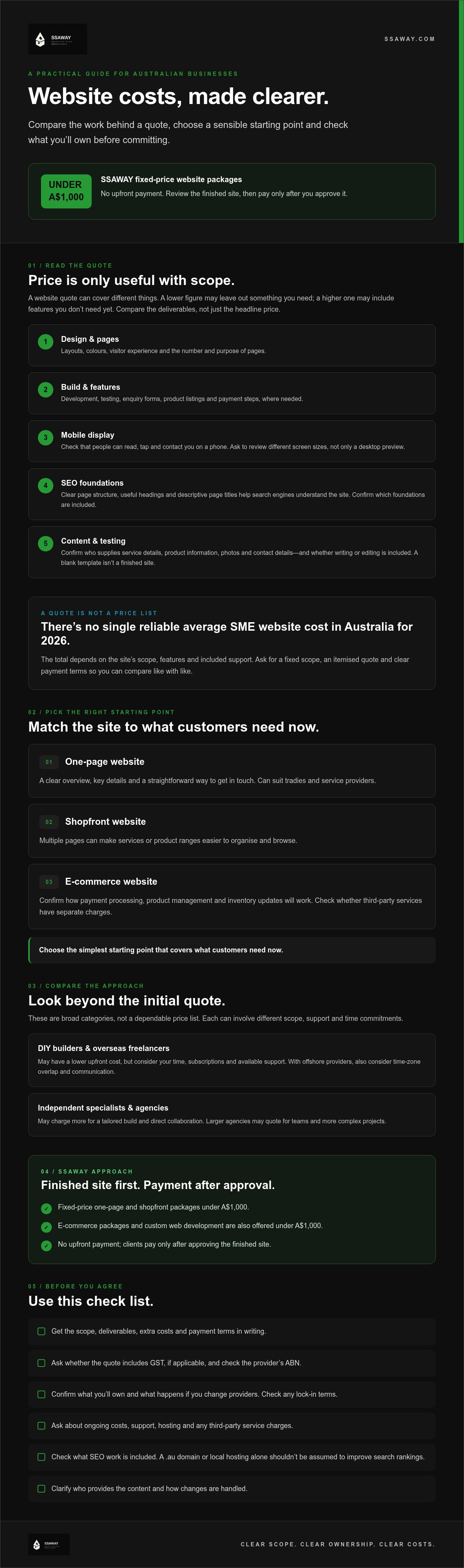
That’s why website development cost isn’t just a design fee. It can include page layouts, mobile display, forms or shop features, the work needed to build and test them, and search engine optimisation (SEO) foundations. Ask the provider to list each item in the agreed scope. A low quote may leave out something you need, while a higher one may include features your business doesn’t need yet.
Quotes from Australian and offshore providers can differ because of labour costs, time-zone overlap and the effort needed to manage communication across locations. A lower rate doesn’t automatically mean poor work, and a local provider isn’t automatically the right fit. Compare the deliverables, who will do the work, how changes are handled and who owns the finished site. Clear answers matter more than a headline price.
Why Price Ranges Vary So Drastically
DIY builders and overseas freelancers may have a lower upfront cost, but that figure doesn’t account for your time, subscriptions or the support available. Independent specialists and agencies may charge more for a tailored build and direct collaboration. Larger agencies may quote for teams and more complex projects. These are broad categories, not a dependable price list. Compare the scope, not the label.
To compare proposals fairly, ask for a fixed scope, an itemised quote and clear payment terms. SSAWAY’s one-page and shopfront website packages are fixed-price and under A$1,000. Clients pay only after approving the finished site, rather than paying an upfront deposit before there’s a completed website to review.
The Role of GST and Local Compliance
Before accepting a quote, check the provider’s Australian Business Number (ABN) and ask whether the quoted amount includes GST, if applicable. Get the answer in writing. A .au domain may help make your Australian audience clear, but don’t assume a local domain or local hosting alone will improve search rankings. Ask what SEO work is included and where the site will be hosted, then weigh those details against your needs.
There’s no single reliable average SME website cost in Australia for 2026, because the total depends on the site’s scope, features and included support. Compare like with like, and make sure the quote explains what’s included, what costs extra and what you’ll own.
The True Cost Components of a Professional Website
A website quote covers more than its appearance. Design shapes the layout, colours and visitor experience. Development turns that design into a working site, including features such as enquiry forms, product listings or payment steps. The website development cost depends on what your business needs and how clearly those tasks are defined in the quote.
Mobile responsiveness matters. Customers should be able to read your content, tap buttons and contact you from a phone without pinching and zooming. Ask to review the site on different screen sizes, not just in a desktop preview.
SEO foundations matter too. Clear page structure, useful headings and descriptive page titles help search engines understand what your site is about. Without those basics, even a polished website can be hard for potential customers to find. A Website cost guide from Forbes also highlights how features and scope affect what a website involves. Check which SEO foundations are included in your quote instead of assuming they come as standard.
Content is another part of the work that can catch business owners out. Gathering service details, product information, photos and contact details takes time. If you’re writing the copy yourself, allow time to make it clear and useful. Before work begins, confirm who supplies the content and whether writing or editing is included. A blank template isn’t a finished, ready-to-use site.
Package Types and Their Value
- One-page websites can suit tradies and service providers who need a clear overview, key details and a straightforward way for customers to get in touch.
- Shopfront websites give businesses room to organise information across multiple pages, making services or product ranges easier to browse.
- E-commerce websites need more than product pages. Confirm how payment processing, product management and inventory updates will work, and whether any third-party services have separate charges.
Choose the simplest starting point that covers what customers need now. SSAWAY offers one-page and shopfront website packages, as well as e-commerce packages and custom web development, all under A$1,000. Clients pay only after they approve the finished site.
Technical Essentials: Domains and Hosting
Domain registration and hosting are ongoing items to check, not details to leave buried in a quote. Ask whose account holds the domain, who controls the hosting, what renewal costs apply and how a transfer would work. Australian-based hosting may be worth considering for local audiences, but performance also depends on the hosting setup and the site itself.
An SSL certificate helps secure the connection between a website and its visitors. Ask whether it’s included, who manages renewals and whether there’s an extra charge. For more help comparing the details, read this affordable website design guide. If you’re weighing up a straightforward starting point, you can also review SSAWAY’s fixed-price website packages and check what’s included before deciding.
Agency vs. Freelancer vs. DIY: A Cost Comparison
The cheapest starting option isn’t always the lowest-cost choice over time. DIY builders put setup in your hands, freelancers offer direct specialist work, and agencies may bring a team to a larger project. Compare what each option includes, how much work falls to you and what happens when the site needs changes.
DIY can look free, but your time isn’t. You may need to organise the pages, write the content, set up the site and troubleshoot problems yourself. Add recurring platform subscriptions and paid extras to your three-year budget. If those tasks take time away from serving customers, consider that trade-off as well.
A freelancer may suit a clearly defined project, but one person may not cover every skill your site needs. Before committing, ask who handles updates after launch, what support is included and how the site can be transferred if the arrangement ends. An agency may offer a broader team, but its proposal should still explain the work and costs plainly.
A smaller, fixed-price provider may suit businesses that want a defined project without a sprawling scope. SSAWAY’s one-page and shopfront website packages are efficient starting points, with all packages under A$1,000. There’s no upfront payment. Clients pay only after approving the finished site.
Total Cost of Ownership Over Three Years
Compare the full three-year picture, not just the first invoice. For a DIY site, add subscription renewals and paid extras, then factor in your setup and upkeep time. For a fixed-price package, check what the price covers and confirm separately whether domain, hosting or ongoing service charges apply. Don’t assume they’re included.
A site can also need substantial work if its structure or content makes it difficult for search engines and customers to understand. That doesn’t mean a more expensive build guarantees rankings. Ask what SEO foundations are included and what you’ll need to do yourself. An upfront deposit puts more payment risk on you before the finished site is available to assess, while pay-on-approval lets you review the completed work before paying.
Scalability: When Does “Cheap” Become Expensive?
A basic builder may be enough at first, but moving platforms later can involve rebuilding pages, transferring content and sorting out site functions. Check how easy it is to export your content and whether you’ll own the domain and site files. If you already know you need features a basic platform can’t handle, custom web development may be a better fit for those specific needs. Start with the one-page website guide for Aussie small businesses to assess whether a simpler site is enough for now.
For a clear starting point, review SSAWAY’s fixed-price website packages and compare the stated scope, ownership and payment terms with any other proposal.
Avoiding Hidden Fees and "Lock-in" Contracts
A quote is only useful if you can see what happens after launch. Check the website development cost alongside ongoing charges, ownership terms and the steps involved if you decide to move your site. A low initial price can become expensive if essential updates or access to your own files come with extra conditions.
Some providers use a proprietary content management system (CMS) that can make a site difficult to transfer. Ask whether the site can be moved to another provider and whether you’ll receive the files and login access you need. Open-source software or a clear transfer process can give you more choice. Also confirm that your business, not the developer, controls the domain registration account.
Maintenance isn’t one vague task. It might include applying software and plugin updates, checking that backups are running, renewing security certificates and fixing issues after an update. Ask which jobs are covered, how often they’re done, what’s excluded and how extra work is approved. A fair fee is one you can assess against a written list of services, not an unexplained monthly amount.
Separate SEO foundations from ongoing marketing. A build may include basics such as search-friendly page titles and clear site structure, while ongoing SEO work could involve regular content, reporting or continued optimisation. Ask what’s included in the build, what any retainer delivers each month and whether you can stop it without losing your website.
Red Flags in Web Design Contracts
- Large upfront deposits: Check the payment stages, what each stage delivers and whether the agreement explains how either party can end the project.
- Unclear third-party fees: Ask for a list of paid plugins, subscriptions and renewals, including who pays for them and whose account they’re attached to.
- Restrictive ownership terms: Read clauses about transferring the domain, site files and content. Be cautious if leaving means losing access to your website.
The “No Upfront Payment” Difference
Paying only after you’ve reviewed the finished site means you can assess the work before paying. It can encourage clear expectations about approval, but it doesn’t replace a written scope or agreement. Confirm what “finished” means, how approval works and what happens if changes are needed. SSAWAY lets clients approve the completed site before payment.
Want to check the terms before you commit? Explore website packages with pay-on-approval.
The SSAWAY Approach: Professional Sites Under A$1,000
A fair website development cost should be clear before work begins. SSAWAY offers fixed-price website packages and custom web development, all under A$1,000. The packages give small businesses a clear price point to compare. There’s no upfront payment.
With SSAWAY, you review the finished site and pay only after you approve it. That means you see the work before making the payment decision, rather than committing a large deposit before there’s a completed website to assess. It’s a practical option for small businesses keeping a close eye on costs.
Be clear about the scope, too. A package price alone doesn’t tell you which features are included. Before proceeding, confirm in writing what the finished site covers, including mobile display, SEO foundations, content, design changes and any external costs. Also ask how approval works, what happens if you request changes and what you’ll own when the project is complete. Straight answers make it easier to compare like with like.
Streamlined Packages for Every Stage
The right starting point depends on what customers need to do on your site. A one-page website can suit a service-based business that needs to present key information in one place. A shopfront gives a business room to organise its pages and offerings. E-commerce packages are designed for businesses selling online, while custom web development is available for requirements that don’t fit a standard package.
There’s no need to build for every possible future today. Start with the features your business needs now, then make sure the agreed scope is specific. SSAWAY offers one-page, shopfront and e-commerce packages, as well as custom development, all priced under A$1,000.
The SSAWAY Difference: No Deposit, No Worries
With no upfront payment, you can assess the completed site before paying. That shifts the focus from collecting a deposit to delivering work you’re comfortable approving. It doesn’t replace a clear agreement, so confirm the scope, ownership and approval process before the project starts. Know what you’re reviewing and what happens next.
To get started, prepare a brief covering your business, the purpose of the site, the pages or shop features you need and the content you can provide. Ask how the finished site will be handed over and what steps are required to publish it. Review the agreed details before work begins.
View fixed-price website packages and start your project.
Make Your Next Website Investment with Confidence
A sensible website development cost isn’t just about the first quote. Check what the work includes, what ongoing charges may apply and whether you’ll retain control of your domain and site files. Clear scope and ownership terms help you avoid surprises later.
The right site is the one that fits your business now, whether that’s a focused one-page website, a shopfront or an e-commerce site. You don’t need to pay for features you won’t use. You do need clear terms, a site that works on mobile and payment arrangements you understand before the project starts.
SSAWAY offers fixed-price website packages under A$1,000, with no upfront payment. You review the finished site and pay only when you approve it. That puts the work in front of you before the invoice arrives.
Explore SSAWAY’s fixed-price website packages and check the scope, ownership and payment terms for a website that fits your business needs.
Frequently Asked Questions
How much does a basic website cost in Australia in 2026?
It depends on the number of pages, features and work included, so compare the scope rather than relying on a headline figure. A one-page site is a simpler starting point than an online shop with product and payment functions. SSAWAY’s fixed-price one-page, shopfront and e-commerce website packages are all under A$1,000. Clients pay only after reviewing and approving the finished site.
Why do website quotes vary so much?
Quotes vary because providers include different work. One proposal might cover a basic build, while another includes more pages, custom features, SEO optimisation or ongoing support. Ask for a written list of deliverables, exclusions and third-party charges, then compare like with like. A higher quote isn’t automatically better value, and a lower one isn’t useful if important requirements are missing.
Do I have to pay a deposit before the work starts?
No, not with every provider. Payment terms depend on the agreement, so check when payments are due and what each payment covers before work begins. SSAWAY requires no upfront payment. You review the finished website and pay only after you approve it. Whatever the arrangement, make sure the scope, approval process and steps for handling requested changes are clear in writing.
What are the ongoing costs of running a website after it is built?
Ongoing costs may include domain renewal, web hosting, paid plugins or other third-party services. Maintenance may also be a separate expense if you want help with software updates, backups or resolving technical issues. Ask which items are included in the build, which renew regularly and who controls the relevant accounts. A written breakdown makes it easier to budget and avoid surprise charges.
Can I update the website myself once it is finished?
That depends on the website platform, your access and how the site is set up. Before the project ends, ask whether you’ll be able to edit page text, images, products or opening details yourself. Confirm what logins and instructions you’ll receive, and whether updates you can’t handle require a separate service. Don’t assume self-editing is included. Get the details confirmed before agreeing.
Is SEO included in the initial development cost?
Sometimes, but the word “SEO” can mean different things. A package may include SEO optimisation as part of the website, while other proposals treat ongoing marketing as separate work. Ask for specific inclusions, such as which pages are covered and what on-site setup is completed. SSAWAY’s website packages include SEO optimisation. Confirm the agreed scope so you know exactly what’s being delivered.
How long does it typically take to build a small business website?
There’s no reliable timeframe that applies to every project. The schedule depends on the agreed scope, how quickly content and feedback are provided, and whether the site needs more complex features. Ask the provider for a project timeline with key stages, including when you’ll review the site and what could affect delivery. Make sure any timing is written into your project agreement.
Will I own my website and domain name completely?
Confirm ownership and access in writing rather than assuming they come with the build. Ask who registers and controls the domain, whether you’ll receive access to the site files and platform, and how a transfer to another provider would work. Check whether any software or third-party services have separate terms. Clear answers help you understand what you can take with you if you change providers.


