
A low headline price can still leave you with an unfinished store. E-commerce website packages vary in what they cover, so the total alone won’t tell you whether a package suits your products, sales needs or available content.
Before you commit, check what the package includes, what you’ll need to provide and whether you can review the finished website before payment. Clear answers make providers easier to compare and help you avoid paying for a package that leaves important work undone.
This guide explains what to look for in an online store package, how to match its scope to your business, and which deliverables, review steps and payment terms to confirm. SSAWAY states that its website packages include SEO optimisation, require no upfront payment, and let clients review and approve the completed website before paying. Use the questions below to assess a package and its terms with confidence.
Key Takeaways
- Compare e-commerce website packages by written deliverables, not by package name or headline claims.
- Map your products and customers’ buying journey before deciding what your store needs.
- Check exclusions, your responsibilities, revision steps and payment triggers before agreeing to a package.
- Judge affordability by whether the scope suits your store, not by price alone.
- Review how SSAWAY’s e-commerce package, SEO optimisation and approval process fit your needs.
What should an e-commerce website package include for an online store?
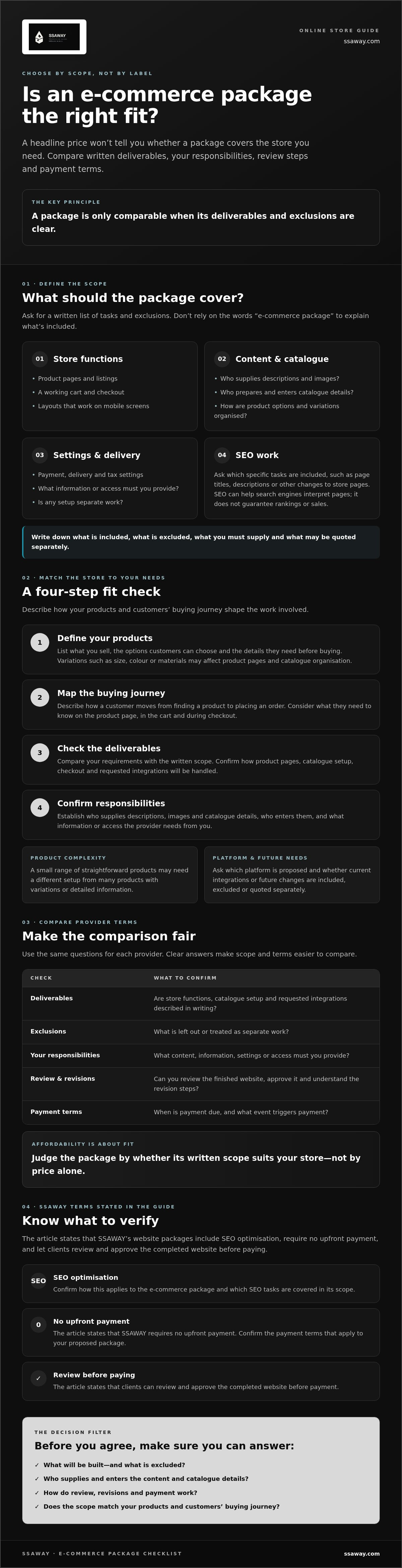
An e-commerce website package is an agreed set of design and development deliverables for setting up a website to sell products online. A store may need product pages, a cart, checkout and layouts that work on mobile screens. But the label “e-commerce package” doesn’t tell you exactly what’s included. Ask for a written list of tasks and exclusions before comparing options.
That clarity matters because two e-commerce website packages can use similar labels but cover different work. A package is only comparable when its deliverables and exclusions are clear. For a neutral overview of the term, see e-commerce.
Which store functions should buyers confirm?
Ask what the provider will set up and what you’ll need to supply. Confirm whether the scope covers product listings, a working cart, checkout and mobile usability. Then clarify how product descriptions, images and the initial catalogue will be handled. Will you provide these materials, and will the provider add them to the store?
Payment, delivery and tax settings also need a clear answer. Ask whether each is included, requires information or access from you, or involves separate work. Don’t assume a feature is covered just because it’s needed to sell online. Record the answer in writing before comparing packages.
What does SEO optimisation mean for an online shop?
SEO, or search engine optimisation, is work that helps search engines understand a website’s pages and content. For a shop, ask which specific tasks are included. For example, does the agreed scope cover page titles, descriptions or other changes to store pages? Treat these as questions to clarify, not features to assume are included.
SEO work can help make pages easier for search engines to interpret, but it doesn’t guarantee rankings or sales. SSAWAY states that its website work includes SEO optimisation. Confirm how that applies to the e-commerce package and which tasks are covered. When comparing providers, ask each one to name the SEO work in the proposed scope.
Before agreeing, check that the written scope covers the store functions you need, identifies who supplies the content and settings, and names anything left out. These details help you judge whether a package fits your store, rather than relying on a label or broad promise.
Match e-commerce packages to your product and sales needs
The right package depends on what you sell and how customers need to buy it. Before comparing e-commerce website packages, work through these steps to describe the store you need and identify gaps in a provider’s proposed scope.
- Define your products. List what you sell, the options customers can choose and the details they need before buying. Variations such as size, colour or materials may affect how product pages and catalogue information need to be organised.
- Map the buying journey. Describe how a customer should move from finding a product to placing an order. Consider what they need to know at each step, including what they’ll see in the cart and during checkout.
- Check the deliverables. Compare your requirements with the provider’s written scope. Confirm how product pages, catalogue setup, checkout and any requested integrations will be handled. Ask what’s included, excluded or quoted separately.
- Confirm responsibilities. Establish who supplies product descriptions, images and catalogue details, and who enters them into the store. Agree on what information or access the provider needs from you.
What should you clarify about products and checkout?
Catalogue size and complexity can change the work involved. A store with a small range of straightforward products may need a different setup from one with many variations or detailed product information. Delivery requirements matter too. Explain how orders should be delivered and ask whether the necessary settings are part of the proposed scope.
Ask the provider to walk you through a typical purchase, from the product page to checkout. Then confirm your role in supplying copy, images and accurate catalogue details. Clear responsibilities help prevent delays and avoid assumptions about who will prepare or enter the content.
How do platform and future needs affect package fit?
Ask which platform the provider proposes and why it suits your products, buying journey and plans. Confirm whether integrations you need now are included. If you may want to change or expand the store later, ask whether that work is covered, excluded or quoted separately. Don’t assume a particular platform or integration comes with a package unless the provider confirms it in writing.
If you don’t need customers to browse products and complete purchases online, a simpler one-page website package may be a better fit. SSAWAY offers one-page and e-commerce website packages. You can compare website package options against your needs before deciding.
How to compare e-commerce website packages and provider terms
Package names don’t tell you what you’ll receive. Compare the written scope, the input required from you and the terms for changes. A written scope makes competing e-commerce packages easier to assess fairly.
| What to compare | What to confirm |
|---|---|
| Deliverables | Which store pages, functions, setup tasks and testing are included? |
| Exclusions | What isn’t covered, and how are additional requests handled? |
| Your responsibilities | Who supplies product copy, photos, policies and other store content? |
| Revisions | How can you give feedback, and what changes are covered? |
| Handover | What will you receive at completion, and is any post-launch assistance included? |
Use the same questions for each provider. If one proposal includes product setup and another leaves it to you, they aren’t like-for-like, even if their package names sound similar. Confirm whether hosting, maintenance and third-party charges are included, excluded or billed separately. Don’t assume ongoing costs are covered by a one-off project scope.
Which questions reveal what a package leaves out?
Ask directly: “What isn’t included?” and “How will extra requests be priced or approved?” Clarify who provides store policies and other content, as well as product information and images. Find out what testing is planned before handover, what you’ll receive when the work is complete, and whether help after launch is part of the agreement. Get each answer in writing.
How can you assess value without comparing price alone?
Consider the work specified, the time and materials you’re expected to contribute, and how you’ll review the completed site. Ask for any proposed timeline, feedback stages and revision terms to be documented. A lower headline figure may not cover the same scope if important tasks are excluded or require extra work.
When comparing project costs, check what each quote covers, what work is left to you and whether any ongoing or third-party charges apply. A price comparison is useful only when you’re comparing similar deliverables and terms.
Is an affordable e-commerce website package too risky? Check these terms first
Not by itself. An affordable package isn’t automatically unsuitable, just as a higher price doesn’t prove a package is more complete. The key is whether the written scope, responsibilities and payment terms match what your store needs. Check these details before agreeing to any e-commerce website package.
What should a clear agreement explain?
Ask for the agreed pages and store functions to be listed, along with anything excluded. Make sure the agreement also explains what you need to provide, how feedback is collected and what happens if you request changes beyond the agreed work.
Then clarify the approval point. When will you review the finished website, how do you confirm approval, and what happens next? Don’t rely on a general promise to ensure you’re happy. Look for a clear process you can understand before work begins.
How can you reduce uncertainty before work begins?
Ask for plain-language answers. If a term is unclear, ask the provider to explain it and record the agreed answer in writing. Keep a record of decisions and any changes to the scope as the project moves forward. This gives both sides a clear reference if expectations differ.
Use this checklist:
- Deliverables: Are the agreed pages and store functions named?
- Exclusions: Is it clear what isn’t included and how extra requests are handled?
- Responsibilities: Do you know what content, access or information you need to supply?
- Feedback: Are review steps and any revision terms explained?
- Payment: Is the payment trigger stated clearly?
Treat promises of guaranteed sales or search rankings cautiously. Ask what specific terms support the claim and make sure those terms are documented. SEO work may be included in website work, but that doesn’t establish a particular ranking or sales outcome.
SSAWAY states that no upfront payment is required and that clients pay after reviewing and approving the completed website. This gives you a stated review point before payment. Confirm the exact approval and payment steps, along with the package deliverables, before proceeding.
To check the provider’s stated approach, see how SSAWAY approaches website projects.
How to get started with an SSAWAY e-commerce website package
A clear brief makes it easier to discuss whether a package suits your store. SSAWAY provides e-commerce website packages and custom development, and states that its website work includes SEO optimisation. Confirm which deliverables and SEO tasks apply to your proposed project before agreeing to the scope. Don’t assume a particular platform, feature or catalogue limit is included unless it’s confirmed.
What information should you prepare before enquiring?
Bring a practical outline of what you sell and how you want customers to buy. Include the products you want to showcase first, any options customers can select, and the key information they need before ordering. You don’t need every detail finalised, but flag anything you’re still working out.
- Products: Describe your range, product variations and the details customers need to make a choice.
- Buying and delivery: Explain how you expect customers to place an order and what delivery requirements you already know.
- Payments and integrations: List any payment methods or connections to other tools you need, then ask whether each is included, excluded or needs separate work.
- Content: Note which product descriptions, images and other store information you can supply, and what still needs clarification.
This preparation gives the provider something concrete to assess. It also helps you identify unanswered questions before they become assumptions in the project scope.
What happens during review and approval?
SSAWAY states that no upfront payment is required and that payment is made after you review and approve the finished website. Use the review to compare the completed work with the deliverables you agreed to. Check the pages and store functions in scope, and raise any differences before confirming approval.
Confirm the exact review and approval steps with SSAWAY before work begins. Ask how you’ll review the finished site, how to communicate feedback and what counts as approval. Payment is stated to follow your review and approval of the completed website. Don’t assume other milestones or change processes unless they’re confirmed in writing.
Once your product, delivery, payment and content requirements are ready, discuss your e-commerce website requirements with SSAWAY.
Choose your store package with confidence
The right fit isn’t simply the package with the longest feature list. Compare e-commerce website packages by their written deliverables, exclusions and responsibilities, then check that the scope matches your products and how customers will buy. Clear review steps and payment terms matter just as much as the store functions.
SSAWAY states that its website work includes SEO optimisation and requires no upfront payment. Clients can review and approve the finished website before payment. Confirm which deliverables apply to your project and how the review and approval process works before proceeding.
Have your product, delivery, payment and content requirements ready? Discuss your e-commerce website requirements with SSAWAY to clarify the proposed scope and terms. With the right questions answered, you can take the next step towards an online store that fits your business.
Frequently Asked Questions
What is included in an e-commerce website package?
An e-commerce website package is an agreed set of design and development work for selling online. It may cover store pages and functions such as product listings, a cart and checkout, but inclusions vary by provider and package. Ask for each deliverable and exclusion in writing. Clarify who supplies product information and images, and whether catalogue setup, payment settings, delivery settings and mobile usability are part of the agreed scope.
How do I choose an e-commerce website package for my business?
Choose a package by matching its written scope to your products and how customers will buy. List your product range, variations and the information shoppers need, then map the steps from product page to checkout. Ask which platform is proposed and why, what integrations are included, and what you need to supply. Compare responsibilities, revision terms, handover and ongoing charges as well as store functions.
Can I get an e-commerce website built without paying upfront?
Yes. SSAWAY states that no upfront payment is required for its website projects. It also says clients can review and approve the finished website before payment. Before proceeding, confirm the deliverables, how you’ll review the completed work, how to give feedback and what counts as approval. Make sure you understand the payment trigger and any process for requesting changes, rather than relying on assumptions.
Are affordable e-commerce website packages suitable for small businesses?
They can be suitable if the agreed scope covers the store functions your business needs and the terms are clear. Affordability alone doesn’t show whether a package is complete or right for your products. Check exclusions, your responsibilities, revision terms, handover and any ongoing or third-party charges. If essential tasks sit outside the package, ask how they’ll be handled before deciding whether the overall arrangement fits.
Do e-commerce website packages include SEO?
Some packages include SEO work, but the specific tasks depend on the provider and agreement. SSAWAY states that its website packages include SEO optimisation. Ask which SEO tasks apply to the e-commerce package, such as work on store pages, and what information you need to provide. SEO optimisation doesn’t guarantee search rankings or sales, so treat those outcomes as separate from the agreed deliverables.
What should I check before approving an online store website?
Compare the finished website with the agreed scope. Check that the pages and store functions you requested are present, then review the product information and test the buying journey from product page through cart and checkout. Check the site on a mobile screen too. Record any gaps or changes and clarify how they’ll be handled. If payment follows approval, confirm that process before you approve.
Can an e-commerce website package include custom development?
It may, but don’t assume custom development is included in a standard package. SSAWAY offers e-commerce website packages and custom web development. Describe any specific requirement, such as a needed integration or change to the buying journey, and ask whether it’s covered by the package or treated as separate development work. Get the proposed work, exclusions and any effect on the project scope confirmed in writing.


