

What if the lowest website quote ends up costing more because key work and ongoing fees weren’t included? Website design pricing is difficult to compare when one quote sets out a clear scope and another leaves room for assumptions.
It’s reasonable to want to know exactly what you’re paying for, what might cost extra and when payment is due. A headline figure alone won’t answer those questions. Compare the work included, the responsibilities on each side and any ongoing costs or account arrangements.
This guide explains what shapes a website quote and how to compare fixed-price, hourly and staged payment approaches. You’ll learn what to check around scope, revisions, domain and hosting arrangements, platform charges, third-party subscriptions and GST before approving a project. Payment timing matters too. SSAWAY requires no upfront payment, and clients can review and approve the finished website before paying. That’s one useful point of comparison, alongside the full scope and terms. Clear answers help you choose with confidence, without relying on the cheapest headline figure.
Key Takeaways
- Compare website design pricing by matching the work, functions and content responsibilities in each quote, not just the headline figure.
- Fixed-price, hourly and milestone-based arrangements handle scope changes, approvals and payment timing differently. Check which approach fits your project.
- Ask what’s included, who controls key accounts and whether domain, hosting or third-party services bring ongoing charges.
- Use a consistent checklist to assess each proposal, starting with your business goals and a clear description of the finished website.
- Payment timing can reduce upfront commitment concerns: SSAWAY requires no upfront payment, and clients review and approve the finished website before paying.
Website design pricing: why quotes differ between projects
Website design pricing is the quoted charge for the agreed design, development and related work on a website project. It isn’t a standard rate based on page count alone. A quote reflects what needs to be built, what the client supplies and what the provider agrees to deliver.
Two proposals can look similar at first but cover different work. One may include a defined set of pages and functions; another may assume you’ll supply all copy and images. Compare the scope line by line, including exclusions and ongoing costs. For broader context on what can shape a quote, see this Australian website design cost guide.
Which project details shape a website design quote?
Start with the pages your website needs, then consider what each page must do. A straightforward information page and one with a custom layout, form or interactive feature may involve different amounts of work. More pages don’t automatically mean better value. Check that each proposed page supports a real business goal.
An online shop can involve product listings, payment setup and decisions about how orders are handled. Ask which shop functions are included and whether you need to supply product information and images. Clarify responsibilities for copy, existing content and revisions too. A proposal should state who prepares or transfers content, how review rounds work and how extra changes are handled. These details affect the work involved, not just the final appearance. The broad scope of the web design process helps explain why a quote may cover more than page layout alone.
What does the quoted amount actually cover?
Separate one-off project work from services or charges that may continue after launch. Design and development describe the work involved in creating the website. Domain registration, hosting, a platform subscription or other third-party services may have separate arrangements or ongoing fees. Confirm what applies, who pays, who manages each account and whether charges recur.
Request the details in writing. Look for the deliverables, exclusions, approval process and definition of a change to the agreed work. If SEO or content tasks appear in the proposal, ask what they involve rather than relying on a broad label. Check whether the quoted amount includes GST, too. Get clear answers before approving the project.
When inclusions, exclusions and responsibilities are spelled out, you can compare proposals on the work they promise rather than on assumptions.
Fixed-price, hourly or staged: compare website design pricing models
A quote’s total tells only part of the story. The billing model also affects how changes are agreed, when you review work and when payments fall due. Compare the terms alongside the deliverables. For a broad market overview, Forbes explains how much a website should cost, but your proposal still needs to spell out its scope and payment conditions.
| Model | Scope changes | Approvals and payment timing |
|---|---|---|
| Fixed-price | Work is priced against an agreed scope. Added features or work outside it may require a separate change request. | Payment dates may be set in the agreement or linked to project stages. Confirm what you’ll review and approve before each payment. |
| Hourly | Charges reflect time spent, so extra requests can add hours. Ask how estimates are updated and how you’ll be told if the work takes longer. | Invoices are generally based on recorded work. Confirm how often you’ll receive progress reports and what approval is needed before additional work begins. |
| Milestone-based | Work and changes should be tied to defined stages. Check how a request affects the next milestone and whether it changes the scope. | Payments are scheduled around agreed milestones. Make sure each milestone has a clear deliverable and approval point. |
These models can overlap. A fixed-price project may still use milestone payments, so check both the pricing basis and payment schedule. See how SSAWAY approaches website projects.
When can a fixed-price website quote make sense?
A defined scope can make deliverables and payment expectations easier to compare across proposals. But “fixed” doesn’t automatically mean everything is covered. Read the written scope, exclusions and revision limits, and check how changes are approved. Ask whether a requested change needs written approval and how any extra work will be assessed before it starts.
How do hourly and staged payments affect project decisions?
Hourly billing can suit work where the full scope isn’t known at the outset. Ask for an estimate, regular time reporting and a process for flagging budget changes early. Staged payments can connect payment to visible progress, provided the milestones and review steps are specific. For either arrangement, check what happens if you pause the project or don’t approve a stage.
If a proposal is vague about revisions or change requests, ask: “What counts as a revision?”, “Who approves extra work?” and “Will you confirm any impact on cost and timing before proceeding?” Clear answers help prevent surprises. Payment timing can also affect your upfront commitment: SSAWAY requires no upfront payment, with clients reviewing and approving the finished website before payment. Compare that process alongside scope, approvals and written terms.
What to check in website design pricing: inclusions, ownership and ongoing fees
A quote is useful only when you can see what sits behind it. Check the deliverables, responsibilities on both sides and any charges that may continue after the project. This makes website design pricing easier to compare and helps prevent assumptions from turning into extra work or unexpected bills.
Use the table as a prompt, not a promise of what every provider includes. Ask for each item to be marked as included, excluded or available at extra cost. For a broader overview, see this affordable website design guide.
| Quote item | What to confirm | One-off or ongoing? |
|---|---|---|
| Design | Which pages and layouts are covered? How many revision rounds are included? | Usually project work; confirm any continuing design support. |
| Development | Are the agreed functions, forms or shop features listed? What counts as extra work? | Usually project work; check for separate platform or software charges. |
| SEO work | What specific tasks are proposed, and what is outside that scope? | Could be one-off or ongoing. Ask what the proposal covers. |
| Content tasks | Who supplies copy, images and product information? Is entry or transfer included? | Confirm whether the work is part of the project or separately ongoing. |
| Domain, hosting and third-party services | Who holds the accounts, who pays, and what happens if you change provider? | May involve recurring fees. Confirm each arrangement directly. |
| Access and handover | What site and account access will you receive? Are transfer steps and support terms documented? | Handover is usually project-related; support may be ongoing. |
Which website deliverables and exclusions should be written down?
Get the finished website described in practical terms: pages, forms, shop functions, content entry and revisions. Clarify who provides copy, images and product details, and when those materials are due. If you request something outside the agreed scope, ask how it will be assessed and approved before extra work begins. A label such as “SEO” or “content” isn’t specific enough on its own. Forbes also outlines how much a website costs, including potential ongoing expenses.
Who controls the website after the project?
Confirm in writing who can access the website, domain and related accounts, and what ownership or transfer terms apply. Check whether hosting, software or other third-party services need separate ongoing payment. Ask what handover includes and whether support after completion is part of the agreement or arranged separately. Clear terms tell you what you’ll control, what you’ll pay for and what happens next.
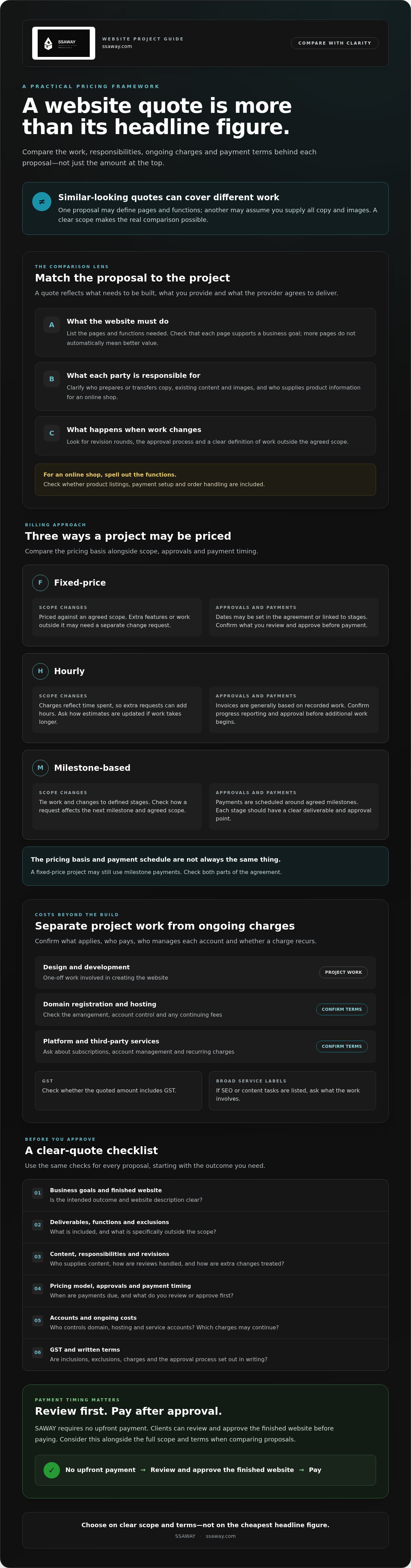
How to compare website design quotes: a practical checklist
Use the same requirements to assess every proposal. That gives you a fairer view of website design pricing and makes gaps easier to spot. Work through this checklist before choosing a provider:
- Set your business goals. Be clear about what the website needs to help you achieve, such as explaining your services or taking online orders.
- List the required functions. Note the pages, forms, shop features or other functions you need. Separate essentials from nice-to-haves.
- Describe the finished website. Ask each provider to confirm what they’ll deliver, including the agreed pages and functions.
- Check inclusions and exclusions. Confirm what design, development, content entry or other proposal items cover, and what’s outside the scope.
- Clarify supplied materials. Ask who provides copy, images and product information, when they’re needed and what happens if they’re delayed.
- Understand revisions and changes. Find out what counts as a revision, how extra requests are assessed, and whether changes affect scope or timing. Get approval terms in writing.
- Check ongoing charges and control. Confirm any domain, hosting, platform or third-party fees, plus who controls the relevant accounts and what handover involves.
- Review approvals and payment timing. Ask when payment is due and what work you’ll see or approve beforehand. Check what happens if you pause the project or request a change.
How can you compare proposals fairly?
Put the same requirements side by side for each provider. Record what’s included, excluded and still unclear. Compare headline figures only after checking that the proposals cover similar work and terms.
| Requirement | Proposal A | Proposal B |
|---|---|---|
| Pages and functions | Included, excluded or unclear | Included, excluded or unclear |
| Content and revisions | Who supplies what? What changes are covered? | Who supplies what? What changes are covered? |
| Ongoing fees and ownership | Charges, access and handover terms | Charges, access and handover terms |
| Approvals and payment | Review points and due dates | Review points and due dates |
Vague terms such as “standard features” or “basic SEO” need a plain-English explanation. Ask the provider to define them and record the answer in the proposal or agreement. Resolve open questions before you commit.
For a clear point of comparison on payment timing, SSAWAY requires no upfront payment, and clients review and approve the finished website before paying. See SSAWAY’s website project approach as you compare your options.
No upfront payment for website design: understand the process and next steps
Paying before you’ve seen the finished website can feel risky. SSAWAY requires no upfront payment, and clients review and approve the finished website before paying. That changes the timing of payment, one factor to weigh when comparing website design pricing. It doesn’t replace checking the project scope or mean every possible change is included.
Before work proceeds, make sure the written terms explain what will be delivered, what you’ll review, how approval works and when payment is due. Confirm ownership and access arrangements, plus any ongoing domain, hosting, platform or third-party charges. Clear terms help you understand the commitment, whatever the payment schedule.
What should clients clarify about review and approval?
Ask what “finished website” means for your project. Confirm which agreed pages and functions will be ready for review, and how you’ll access or view the work. Find out how to request changes before approval, how those requests are assessed and whether they could affect the scope or timing. Don’t assume revisions are unlimited. The payment point and approval steps should be stated clearly in the project terms, so you know what happens before payment is due.
Which SSAWAY website option may fit your project?
Start with what the website needs to do. A one-page website may suit a focused set of information, while a shopfront or e-commerce website may fit a project with broader website functions or online selling. These categories aren’t a shortcut to choosing: confirm the actual requirements and inclusions for your project. If your needs don’t fit a standard direction, custom web development may be worth discussing.
SSAWAY provides one-page, shopfront and e-commerce website packages, as well as custom development. Its projects are priced under A$1,000, with no upfront payment required. Ask how the proposed option would meet your requirements, what it includes and what falls outside the agreed scope. Before you approve anything, confirm the deliverables, approval process, ownership terms and any ongoing charges in writing.
Want to discuss the website your business needs and clarify the project terms? Discuss a website project with SSAWAY.
Choose your website quote with confidence
Good website design pricing is about more than the headline figure. Compare what each proposal delivers, how changes are handled and which ongoing charges may apply. Make sure the scope, ownership arrangements and approval steps are clear in writing before you commit.
Payment timing matters too, but it’s one part of the decision, not a substitute for checking the terms. Its options include one-page, shopfront and e-commerce website packages, plus custom development. Confirm the right fit and exact inclusions for your project.
Ready to talk through what your business needs? Discuss your website project with SSAWAY. With clear questions and written answers, you can compare proposals fairly and take the next step with confidence.
Frequently Asked Questions
How much does website design pricing vary in Australia?
Website design pricing varies with the project’s scope, functions, content requirements and agreed deliverables. A focused one-page website and a site with shop functions, payment setup or custom development involve different work, so compare proposals only after checking what each covers. Ask providers to state inclusions, exclusions and ongoing charges in writing. Don’t rely on a headline figure without understanding the work and terms behind it.
What should a website design quote include?
A useful quote describes the work and what you’ll receive. Check that it identifies the agreed pages and functions, content responsibilities, revision limits, exclusions, approval steps and payment timing. It should also clarify ownership and access, plus any arrangements for domain, hosting, platforms or third-party services. If the proposal mentions SEO or content tasks, ask what specific work those labels cover. Confirm whether the quoted amount includes GST.
Is fixed-price website design better than hourly billing?
Neither model is automatically better. A fixed price can make costs and deliverables easier to understand when the scope is clear, but exclusions and change-request terms still matter. Hourly billing charges for time spent, so ask how estimates, work records and budget changes will be reported. Choose based on how well the model suits your project and how clearly the provider explains approvals, scope changes and payment timing.
Can you pay a website designer after approving the finished website?
Some providers offer payment after the client reviews and approves the finished website, but payment terms differ, so check the agreement. Confirm what “finished” means, how you’ll review the work, how requested changes are handled and when payment is due. This payment timing is one comparison point, not a substitute for clear project terms.
Are hosting and domain fees included in website design pricing?
Not necessarily. Hosting and domain arrangements vary by proposal, and platform or third-party services may also involve ongoing charges. Ask whether each item is included, separately billed or paid directly by you. Confirm who controls the relevant accounts, who manages renewals and what happens if you move the website elsewhere. Get the details in writing rather than assuming these services are covered by the initial project quote.
Does a website design quote include SEO?
It may, but the term “SEO” can refer to different tasks. Ask the provider to list exactly what the proposal covers, such as specific setup or optimisation work, and what is excluded. Check whether the work is one-off or ongoing, and whether any third-party services are involved. SSAWAY offers SEO optimisation, but confirm the precise tasks and inclusions for your project before approving a quote.
How do I compare website design quotes fairly?
Give each provider the same project requirements, then compare the written proposals side by side. Check deliverables, exclusions, content responsibilities, revision and change terms, ongoing charges, ownership, approval stages and payment timing. Ask for plain-English definitions of vague terms such as “standard features”. Keep a list of unanswered questions and get written clarification before choosing. That way, you’re comparing the work and terms, not just the headline price.


