
The lowest website quote can become the most expensive choice. Website design cost australia can be hard to judge when providers include different work, features and support. A lower upfront figure may leave key items out, while ongoing expenses can appear after the site is built.
It’s reasonable to want a clear price and know what you’re paying for. This guide explains what shapes a website quote, how to compare proposals fairly and which costs to plan for beyond the build. You’ll also get a clearer sense of which features your business needs and which may be unnecessary.
We’ll look at scope, page numbers, design and functionality, then cover ownership, hosting, domains, maintenance and other ongoing expenses. The aim is to help you compare like with like, spot gaps before you commit and choose a website that fits your business without paying for features you won’t use.
Key Takeaways
- Website design cost australia depends on the work included, not just the figure at the bottom of a quote.
- Match pages and features to your business needs, from useful forms to booking functions.
- Compare proposals against the same brief, checking revisions, content, platform, ownership and support.
- Separate the initial project scope from recurring platform and service commitments when setting your budget.
- Choose the simplest option that fits your goals, whether that’s a one-page, shopfront, e-commerce or custom website.
Website design cost in Australia: why quotes vary
Comparing website quotes can feel like comparing different jobs. One provider may include content setup and custom functions, while another prices only the core build. Both may call the result a business website, but the work behind that label can be quite different.
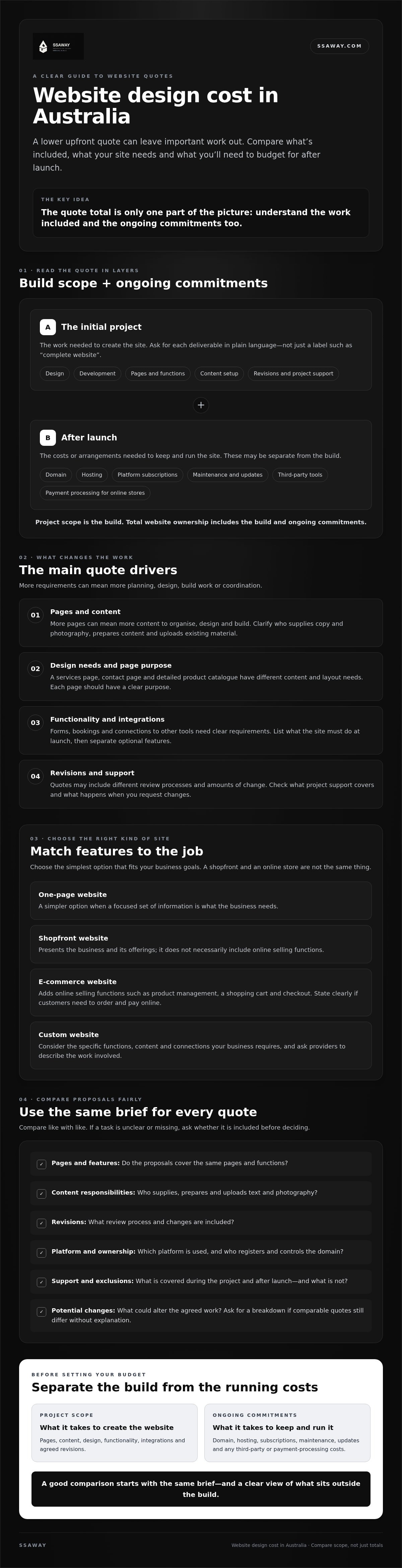
Website design cost is shaped by project scope, functionality and ongoing commitments. The first two determine what it takes to create the site. Ongoing commitments cover what you may need to pay for or arrange after launch. That’s why a headline figure alone doesn’t tell you what website design cost australia businesses should expect for their particular requirements.
Web design can cover the way a site looks, works and is organised. Wikipedia offers a broad introduction to what web design is. When reviewing a quote, the practical question is simpler: exactly what work will the provider do, and what will remain your responsibility?
What does a website design quote usually cover?
A proposal may include design, development, content setup and agreed project support. Those labels don’t explain how much work is included. Check which pages and functions are covered, who supplies and uploads the text, what support is provided during the project and how requested changes are handled.
Ask for deliverables in plain language. “Complete website” needs clarification: does it include the pages and features you discussed, or only a basic build? If a task isn’t listed clearly, ask whether it’s included before you compare or accept the quote.
Why can website design quotes differ so much?
More pages usually mean more content to organise, design and build. A straightforward information page has different requirements from a page with a booking function, a form that sends details to another system or an online shop. The work can also change if content needs preparing or the site must connect with other tools.
Revisions matter, too. A quote with an agreed review process may cover a different amount of work from one with limited changes. Neither is automatically better; the terms need to be clear.
Separate genuine scope differences from unexplained gaps. Ask each provider to describe what’s included, what’s excluded and what could change the agreed work. If two proposals cover the same pages, functions, content responsibilities and support but the difference still isn’t explained, ask for a breakdown.
Project scope is the work required to build your website; total website ownership includes that work plus the ongoing commitments needed to keep and run it. This distinction helps you assess the full proposal, not just the build.
What drives website design cost in Australia?
The work behind a site depends on what it needs to do. A small set of pages with clear information takes a different approach from a site with custom functions, substantial content or online sales. Page count, content readiness, design needs, functionality, integrations and revision requirements are the main factors that shape a website quote.
How do pages, content and custom features affect the quote?
Each page needs a purpose. A services page, contact page and detailed product catalogue call for different content and layouts. More pages can mean more planning, design and build work, particularly when each needs distinct content or features.
Clarify who supplies and prepares the copy and photography, and who moves existing content into the new site. If you’re providing these materials, ask what format they need to be in and whether uploading them is included. Clear responsibilities help prevent content tasks from being assumed by both sides or missed altogether.
Interactive features add another layer. A contact form may need to collect specific information, while a booking function or connection to another tool needs its requirements agreed in advance. Prioritise what the site must do at launch, then list optional features separately. This gives providers a consistent brief to quote against.
A shopfront website and an e-commerce site aren’t the same thing. A shopfront can present a business and its offerings; e-commerce adds online selling functions such as product management, a shopping cart and checkout. If customers need to order and pay online, say so clearly in the brief.
What extra costs can sit outside the design project?
The build quote may not cover everything needed to keep the site running. Check who registers and controls the domain, what hosting is included and whether platform subscriptions are separate. For an online store, confirm how payment processing is handled and whether charges apply. Third-party tools may also have their own subscription costs.
Maintenance and future updates can be separate arrangements, too. Ask what support is included after launch, what counts as an update and who handles ongoing platform or tool costs. Don’t assume these are covered just because the proposal says “support”.
For help thinking through digital needs, business.gov.au provides information about Australian Government advisory services. Check the program details, including eligibility and availability, before relying on it.
Once you know which functions you need, compare them with the available website package options. The right fit depends on your actual scope, not the length of a feature list.
How to compare Australian website design quotes fairly
Start with one shared project brief. Send the same requirements to each provider, then compare what they’ve agreed to deliver, not just the headline figure. This is the fairest way to assess website design cost australia and see whether proposals cover the same work.
A fair quote comparison starts with matching deliverables, because different scopes can’t be judged by price alone. Use a simple table to record what each proposal says:
| Compare | What to check |
|---|---|
| Scope | Pages, functions and agreed project tasks |
| Revisions | Included changes, approval stages and process for extra work |
| Content | Who supplies, prepares and uploads text and images |
| Platform | Which platform the site will use and any separate subscriptions |
| Ownership | Who controls the domain, website files and administrator access |
| Ongoing support | What help is included after launch and what is arranged separately |
Wider web development market trends can offer general industry context, but they can’t tell you whether an individual proposal covers your requirements. The written scope can.
Which questions should you ask before accepting a quote?
Get the details in writing. Ask which pages and functions are included, who handles content tasks, how many revision rounds are allowed and when you’ll review and approve the work. Find out how requests outside the agreed scope are assessed and approved before extra work begins. Also confirm who controls the domain, website files and administrator access when the project is complete.
Check the payment and approval process, too. SSAWAY states that there’s no upfront payment and clients can review and approve the finished website before payment. Whatever provider you consider, make sure the proposal explains its own terms clearly.
How can you spot an incomplete or risky proposal?
Unclear deliverables aren’t proof that a proposal is poor, but they are a reason to ask follow-up questions. Look for named exclusions, unclear ownership, undefined revision limits, and recurring charges or third-party services that haven’t been identified. Ask what happens if a feature needs extra work, and get the answer documented.
A low headline figure may reflect a narrower scope rather than a better deal. Compare the gaps: if one quote excludes content setup or ongoing support while another includes it, note the difference before deciding. If a provider can’t explain what’s included, what’s excluded and how changes are handled, you don’t yet have enough information to compare fairly.
How to budget for a website and avoid unexpected costs
A clear budget starts before you request quotes. Decide what the site needs to achieve, then separate the build from costs that may continue after launch. This makes website design cost australia easier to assess and helps you catch missing items before choosing a provider.
- Define the goal. Identify who the site is for, what you want visitors to do and which information they’ll need. Keep the brief focused on business outcomes, not features for their own sake.
- Prioritise features. Mark each requirement as essential, useful or a later addition. A booking function, for example, belongs in the essential group only if it’s needed at launch.
- List ongoing needs. Note domain renewals, hosting, platform subscriptions, payment tools, third-party services, maintenance and future updates. Ask who manages each item and whether it’s billed separately.
- Request comparable quotes. Send the same brief to each provider. Ask them to identify inclusions, exclusions, recurring commitments and how out-of-scope requests are handled.
Keep initial project commitments separate from recurring obligations. Ask providers to clarify which charges are one-off and which may repeat. Confirm whether GST is included in quoted amounts, and verify current Australian tax treatment and any third-party charges rather than assuming they’re covered. The provider should make clear what you pay for directly and what, if anything, they manage.
How should you set a realistic website brief?
Start with your audience, the main action you want visitors to take and the information they need to make a decision. Then sort features into essential, useful or later. A focused brief helps prevent scope creep and gives each provider the same basis for identifying inclusions and exclusions. If one page can meet your current goals, this one-page website guide can help you assess that simpler scope.
Which ongoing website commitments should you plan for?
Check who handles hosting, domain renewals, updates and technical support, and whether each is included or arranged separately. Ask whether payment tools or other third-party services have their own charges, and how future updates are requested. For more ways to keep the project scope focused, read this guide to affordable website design.
Once your priorities are clear, compare them with SSAWAY’s website package options to see whether a one-page, shopfront, e-commerce or custom development option better matches your needs.
Choosing a website design option that fits your business
The right website isn’t the one with the most features. It’s the simplest option that meets your business goals now, without paying for functions you don’t need. That’s a useful way to think about website design cost australia: match the scope to the job the site needs to do.
Which website format suits your business requirements?
- One-page website: Consider this if your essential information can fit clearly on one focused page, with a straightforward path for visitors to take action.
- Shopfront website: A useful option for service businesses that need separate pages to explain their services and help visitors find the right information.
- E-commerce website: Relevant when customers need to browse a product catalogue and place orders through online checkout.
- Custom development: Consider this when your requirements go beyond what a standard website format can handle. Define the specific function or process you need before comparing proposals.
Use those descriptions as a starting point, not a rule. A business with a small, clearly defined offering may not need a large site. A business selling products online has different requirements from one that only needs to explain its services. SSAWAY provides one-page, shopfront and e-commerce website packages, as well as custom development. Its projects are priced under A$1,000, with no upfront payment required. The best fit depends on your actual scope.
What should you confirm before starting a website project?
Before work begins, agree on the pages, functions and other deliverables in scope. Confirm who is responsible for supplying content, what approval stages apply, how extra requests are handled and who will control the website and its access. Check that the selected option covers every essential requirement. If something important is missing or unclear, resolve it before the project starts.
When the site is ready, review it against the agreed requirements. Check that the expected pages and functions are present and that agreed changes have been addressed. SSAWAY states that clients can review and approve the finished website before payment, with no upfront payment required. Make sure you understand the approval and payment terms for any provider you consider.
Choose based on fit, clarity and agreed scope, not on features you may never use. If you’re ready to compare options, Explore SSAWAY website design options.
Choose a website scope with confidence
The clearest way to assess website design cost australia is to compare what each provider will actually deliver. Match the scope to your business goals, check what’s included and excluded, and account for ongoing commitments as well as the initial project.
Keep the choice practical. A one-page, shopfront or e-commerce package may suit your needs, while custom development can address requirements that need a tailored approach. The right fit covers your essential requirements without adding features you don’t need.
SSAWAY offers these website options and custom development, with projects priced under A$1,000. Its stated process requires no upfront payment, and clients can review and approve the finished website before payment. Clear terms and a chance to check the completed work can help you make a more informed decision.
Ready to see which option could fit your business? Explore straightforward website design options. Start with your goals, ask direct questions and choose your next step with confidence.
Frequently Asked Questions
How much does website design cost in Australia?
Website design cost in Australia varies with the scope, features and ongoing commitments included. The phrase “website design cost australia” doesn’t point to one set price: a focused information site and an online shop have different requirements. To understand a proposal, check which pages and functions are included, who supplies the content, and whether hosting, platform charges or support are separate. Compare written scopes before judging the figures.
What affects the cost of designing a website?
The main factors are the number and purpose of pages, design and build requirements, content preparation, custom functions and integrations. For example, a basic contact form has different requirements from a booking feature or an online checkout. Revisions and content migration can also add work. Before requesting quotes, separate must-have functions from later ideas so providers can estimate the same practical scope.
What should be included in a website design quote?
A useful quote spells out the pages, design and development work, functions, content responsibilities and agreed project support. It should also explain revision limits, approval stages, exclusions and how extra requests are handled. Check who controls the domain, website files and administrator access. If the proposal uses broad terms such as “complete website”, ask the provider to list the actual deliverables in writing before you accept.
Are website hosting and maintenance included in the design cost?
Not necessarily. Hosting, domain renewals, platform subscriptions, maintenance and future updates may be separate from the website build. Check who arranges and manages each item, what support is included after launch and whether third-party tools have their own charges. Ask the provider to identify recurring commitments in writing. That way, you can plan beyond the initial project and avoid assuming ongoing services are covered.
Why do website design quotes vary between providers?
Quotes vary because providers may include different pages, content tasks, functions, revisions, platforms and support. One proposal might cover content setup, while another expects you to supply and upload everything. Compare the same brief against each quote, then ask about unclear inclusions or exclusions. A price difference may reflect a real scope difference, but the provider should be able to explain what accounts for it.
Is a cheaper website design quote always the better option?
No. A lower headline figure may cover fewer pages or exclude content, functions, revisions or ongoing support. Compare the deliverables, ownership terms and recurring commitments before deciding. Ask what would count as extra work and how changes are approved. If the proposals don’t cover the same requirements, request clarification rather than choosing on price alone. The better fit is the one that meets your needs with clear terms.
Can I review a website before paying for the design?
That depends on the provider’s payment and approval process, so confirm the terms before work begins. SSAWAY states that no upfront payment is required and clients can review and approve the finished website before payment. Agree on the requirements you’ll use to assess the completed site, and clarify how approval works. This gives you a defined basis for checking the result against the agreed scope.


