
Could a polished website still lose you an enquiry? Absolutely. If visitors can’t quickly understand what you offer or what to do next, attractive colours and animations won’t solve the problem. Effective website design starts with the visitor’s next action, not the latest trend. For Australian businesses planning a new website, the key question is what customers need from the site. Whether you are launching a fresh digital presence or upgrading an existing platform, the same practical test applies: does the site help visitors find what they need and take the next step?
A professional-looking site matters, but it also needs to be clear, useful and built around a business goal. The right approach depends on whether you need a focused one-page site, a shopfront, an online store or custom features.
This guide explains what effective website design needs to do, compares common approaches and gives you a practical checklist for planning your next step. It also covers why mobile usability, accessibility and search visibility belong in the conversation from the start. SSAWAY’s website packages include SEO optimisation. Projects are fixed-price, with no upfront payment, and you can review and approve the finished website before paying. Start with clear priorities, choose an approach that fits, and know what comes next.
Key Takeaways
- Start with the action you want visitors to take, then shape the site around making that step clear.
- Use straightforward navigation, readable content and mobile-friendly layouts to make your website easier to use.
- Compare one-page, shopfront, e-commerce and custom approaches by the content, visitor tasks and functions your business needs.
- Use a practical website design checklist to clarify your audience, goal, key content and essential features before a project starts.
- SSAWAY’s website packages include SEO optimisation, and you can review and approve the finished website before paying.
What effective website design should do for an Australian business
Website design is the structure, appearance and interactive features that shape how people experience a website. It goes beyond choosing colours or arranging images. Design influences how visitors find information, understand an offer and decide what to do next. A good-looking site is useful to a business when it also helps people find answers, make an enquiry or complete a purchase.
Use this as a practical test: can someone arrive, recognise that they’re in the right place and take a sensible next step without unnecessary effort? The principles cover page layout, content and interaction, as outlined in this Web design principles and overview. When comparing options for website design perth, judge the site by how clearly it serves visitors, not by how many visual effects it uses.
Start with the visitor’s goal
Imagine someone landing on a page for the first time. They might want to understand a service, compare options, check product details or buy something. Give each task a clear path. Put useful information where visitors can find it, group related details together and use headings that describe what each section contains.
Then review the prominent elements on the page. Does the main heading explain the offer? Does the navigation lead to useful information? Does the button say what happens next, such as “Request a quote” or “View products”? Each element should support a useful action. If a page presents several competing choices, visitors may not know where to go.
A clear structure saves visitors from searching through long blocks of text or guessing what a vague button means. It also helps the business explain its offer directly and consistently.
Make design serve the business goal
Different businesses need different visitor journeys. A service business may need to explain what it does, show how to enquire and make key details easy to find. A retailer may need clear product categories and useful product information. An online shop needs to make browsing, choosing and purchasing straightforward. The layout should fit the task rather than force every business into the same design.
Trust starts with clear, accurate information. Use current contact details, describe services plainly and make important terms easy to find. Product pages should give shoppers the information they need to make a considered choice. Avoid claims the business can’t support. A polished design can attract attention, while dependable information gives visitors a reason to act.
Visual choices matter too. Readable type, deliberate spacing and consistent page patterns help people understand what they’re seeing. For businesses considering website design perth, each design choice should make the experience clearer or the next step easier. For a closer look at current ideas and how to apply them thoughtfully, explore the 2026 Australian web design trends guide.
The design elements that make a website clear, usable and credible
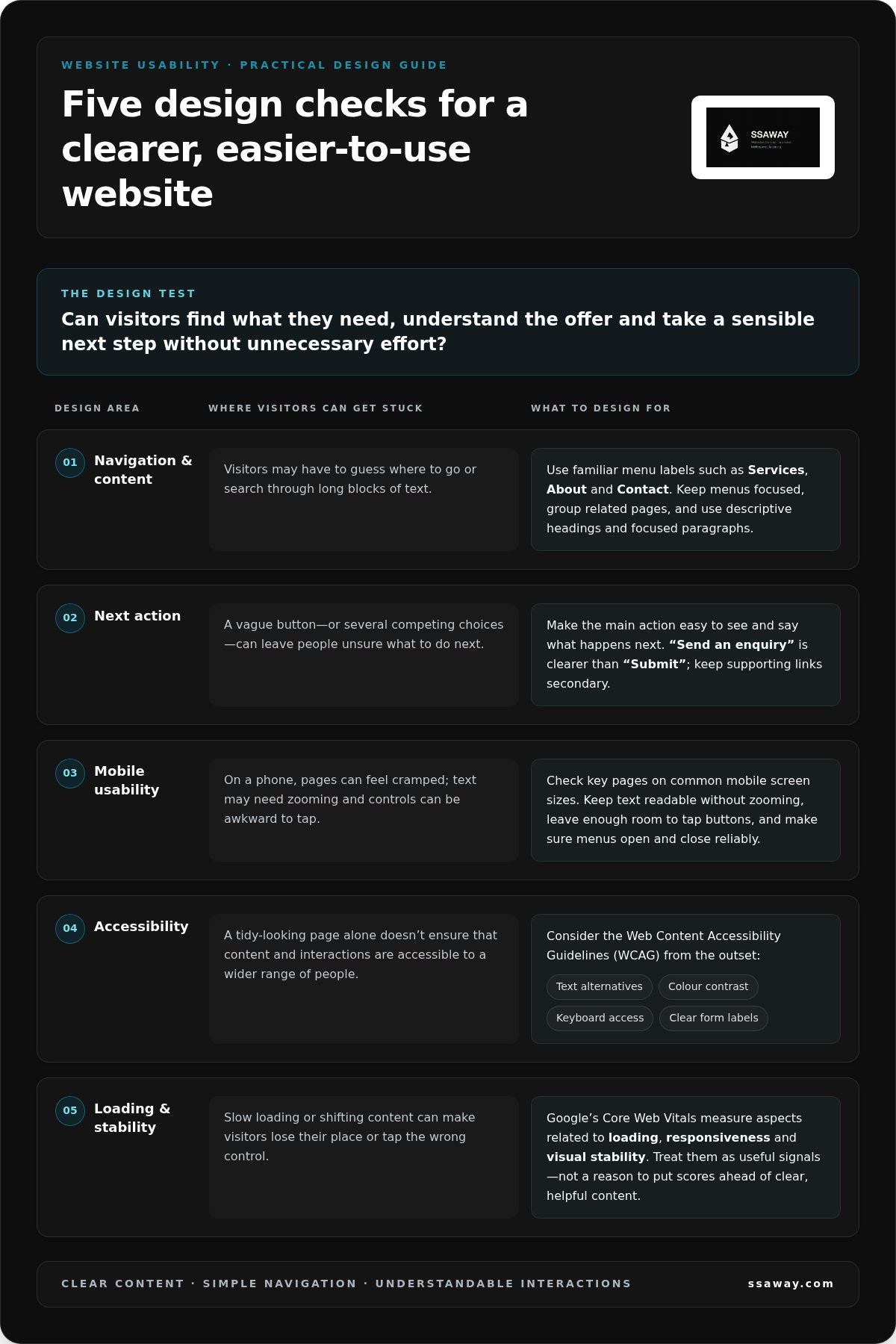
Usable design brings clear content, simple navigation and understandable interactions together. Visitors shouldn’t have to guess where to go, pinch and zoom to read a page, or wonder what a button will do. These basics make a site easier to use and help the business present itself clearly.
Navigation, content and calls to action
Choose menu labels that match what visitors are looking for. “Services”, “About” and “Contact” are more useful than clever labels that obscure a page’s purpose. Keep the menu focused, group related pages together and use the same navigation pattern across the site. Familiarity helps visitors find their way.
Make pages easy to scan. Use headings that describe the content beneath them, keep paragraphs focused and add links when they help someone find a relevant detail. For example, a service overview could link to a page explaining how to enquire. A website design checklist and best practices can also help organise decisions about content and page structure.
Make the next step clear in each call to action. “Send an enquiry” tells visitors more than “Submit”. Put the main action where it’s easy to see, and use supporting links for secondary tasks. Avoid making every button compete for attention.
Mobile usability, accessibility and speed
A page that works on a desktop can feel cramped on a phone. Check key pages on common mobile screen sizes. Make sure text is readable without zooming, buttons have enough room to tap, and menus open and close reliably. Keep important information visible rather than burying it beneath oversized decorative elements.
Accessibility means making content and interactions easier for a wider range of people to use. The Web Content Accessibility Guidelines (WCAG) provide a framework for considering areas such as text alternatives, colour contrast, keyboard access and clear form labels. Treat these as design considerations from the outset. Don’t assume a site meets accessibility standards just because it looks tidy.
Speed and visual stability matter to the experience too. If a page takes too long to load or content shifts as it appears, visitors can lose their place or tap the wrong control. Google’s Core Web Vitals measure aspects related to loading, responsiveness and visual stability. They’re useful signals to consider, not a reason to prioritise a score over clear, helpful content.
If you’re planning a site around these practical features, explore SSAWAY’s website options. A clear brief helps match the site’s structure and functions to what visitors need to do.
How to compare website design approaches for different business needs
The right website approach isn’t the one with the longest feature list. It’s the one that helps visitors do what they came to do without adding unnecessary complexity. Start with the content you need to present, the actions visitors should take and any specific functions your business relies on. This is a useful way to assess options for website design perth as well as other markets.
| Approach | Content needs | Visitor task | Functionality level |
|---|---|---|---|
| One-page | A focused offer with a concise set of key details | Understand the offer and take one clear next step | Simple, focused journey |
| Shopfront | Information about a business and its services or offerings | Explore what’s available and decide how to proceed | Structured presentation of business information |
| E-commerce | Product information arranged for online browsing | Browse, choose and purchase online | Online shopping journey |
| Custom development | Content and functions shaped around specific project needs | Complete tasks that require a tailored website experience | Project-specific functionality |
Use the table as a starting point, not a rigid rule. A small service business with one main offer may need a concise page that explains the service and makes enquiring straightforward. A business with several services may need more room to give each one clear, useful information. A shop needs to help visitors browse and buy. Custom development suits requirements that call for a tailored structure or function.
When a focused one-page site may fit
A one-page site can suit a business with a focused offer and a straightforward visitor journey. Visitors move through the main information on a single page, from the introduction to details and the next step. The trade-off is space: distinct services or topics can become harder to separate and find as content grows. A one-page website guide for Australian small businesses can help you decide whether this concise format matches your needs.
When a shopfront, e-commerce or custom site may fit
A shopfront can organise business information so visitors can explore services and find a way to enquire. E-commerce is a better fit when people need to browse products and complete purchases online. Custom development is worth considering when the visitor journey or required functionality doesn’t fit a straightforward structure. The aim is to match the build to the task, not make the site complex for its own sake.
Before choosing, write down the visitor’s main task and the essential content or functions needed to support it. A clear brief makes it easier to compare one-page, shopfront, e-commerce and custom options by purpose rather than appearance alone.
A practical website design checklist to use before a project starts
A clear brief makes decisions easier. It gives the website a purpose, keeps the content focused and helps you choose an approach that fits. A useful brief connects the audience, goal, content and next action. Write it in plain language. You don’t need technical terms to explain what the site should help people do.
Prepare the content and purpose
Start by defining who the website is for and what those people need to know or do. List the questions they’re likely to arrive with, then use those questions to shape the pages or sections. For each key page, name the main action visitors should take. Keep the content focused on what supports that task.
- Define your audience. Describe the people you want to reach and what they’re looking for.
- Set the business goal. Decide whether the site should support enquiries, explain services, present products or enable online purchases.
- List visitor questions. Note what people need to understand before taking action, such as what you offer or how to proceed.
- Map the core content. Turn those questions into essential pages or sections. Leave out material that doesn’t help visitors make a decision.
- Choose the next action. Identify one primary action for each key page, such as sending an enquiry or viewing products.
- Name essential functions. Describe what visitors need to do, for example, submit a form or complete an online purchase. Avoid unexplained technical jargon.
- Set content priorities. Mark what must be ready for the site and what could be added later. This helps keep the initial brief manageable.
Plan for discoverability and ongoing use
Consider how visitors and search engines should understand each page. Draft descriptive page titles, clear headings and useful content that matches the subject. People use Google Search to discover relevant pages, but planning for search doesn’t guarantee rankings. It gives each page a clear topic and helps visitors decide whether it answers their needs.
Also decide who will update the content and what may change over time, such as service details, product information or contact pathways. A practical affordable website design guide can help you weigh priorities before settling on a scope.
Once your brief is clear, compare it with a one-page, shopfront, e-commerce or custom-development approach. SSAWAY offers these options, and its website packages include SEO optimisation. Plan your website project with SSAWAY, using your audience, goals and essential functions to guide the next step.
How SSAWAY makes website design and approval straightforward
A website project is easier to plan when the approach, price and approval process are clear. SSAWAY offers one-page, shopfront and e-commerce website packages, alongside custom development. The right starting point depends on what your business needs the site to do and how visitors will use it.
Each website package includes SEO optimisation. Discoverability is considered as part of the website project, alongside the visitor experience. Clear page content and a well-organised structure can help people understand what a site covers. SEO optimisation supports this work, but it doesn’t promise specific search rankings.
A clear project and payment approach
Projects are fixed-price, cost under A$1,000 and require no upfront payment. The price is agreed for the project rather than presented as a one-size-fits-all amount. This gives you a defined basis for the work while recognising that websites can have different scopes and requirements.
You can review and approve the finished website before paying. That gives you the chance to see the completed site before payment is due, rather than relying only on a description of what it might look like. It’s a straightforward approval process with a clear step before payment.
Before a project begins, prepare a brief that sets out the audience, business goal, content visitors need and main action they should take. Include any essential functions, described in everyday language. These details help connect the project scope to the way people will use the finished website.
Choose a starting point that fits the project
A one-page website package can suit a focused offer and a simple visitor journey. A shopfront package can present business information in a structured way. An e-commerce package is designed for a business whose visitors need to browse products and purchase online. Custom development is another option when a project calls for a tailored website approach.
Don’t choose based on the number of features alone. Start with the business goal: do visitors need to understand a service, send an enquiry, explore a shopfront or buy products? Then identify the content and functions that support that journey. This keeps the decision grounded in what the website needs to do, rather than features that may not serve the visitor or business.
With the goal and visitor journey in view, you can explore website design with SSAWAY and choose a starting point that fits your project. SSAWAY’s projects are fixed-price, with no upfront payment, and you can review and approve the finished website before paying.
Take the next step with a clear website goal
Your next move doesn’t need to be a long list of features. Choose one outcome your website should support, then use it to guide decisions about content, structure and functionality. That keeps the project focused on what matters to your business and the people who visit your site.
If you’re planning website design perth, start by turning that outcome into a simple brief: who the site is for, what visitors need to know and what you want them to do. You can then choose an approach that fits, from a focused page to a broader shopfront or a more tailored build.
Ready to put your priorities into action? Explore website design with SSAWAY and take the next step towards a website shaped around your business goals. A clear starting point makes the rest easier.
Frequently Asked Questions
What makes website design effective for a small business?
Effective design helps the right visitor understand what the business offers and what to do next. Test it against real tasks: can someone find your opening hours, understand how a service works or locate product details without unnecessary effort? Prioritise the information customers need to make a decision. Remove outdated details and distractions that don’t support those decisions.
Does website design affect SEO?
Yes. A site’s structure and content can affect how search engines understand its pages and how easily people use them. Descriptive page titles, useful headings, sensible links and pages that work well on mobile all contribute to a sound foundation. They don’t guarantee a particular position in search results. Treat SEO as ongoing work: keep key information accurate and make each page useful for the query it addresses.
Is a one-page website enough for a business?
It can be, if the business has a focused offer and visitors can get the information they need in one place. It may become difficult to use if customers need to compare several services, find detailed answers or browse a range of products. Consider what visitors need to know before acting. If distinct topics need their own space, a multi-page structure may make those details easier to find.
What should a website design brief include?
A useful brief names the intended audience, the business outcome, the information visitors need and the action each important page should support. Add examples of questions customers commonly ask, existing content that should stay current and any essential functions, such as an enquiry form. Describe what those functions need to do in plain English. This gives the project direction without requiring specialist design or development language.
Should a business website be designed for mobile phones first?
Designing for mobile early is practical because it makes the team decide what information matters most on a small screen. Check that menus, forms and buttons remain easy to use, and that important details aren’t hidden or awkward to reach. Then review the same pages on larger screens. A mobile-first process should keep content clear across screen sizes, not simply shrink a desktop layout.
When should a business redesign its website?
Consider a redesign when the site no longer reflects what the business does or makes common tasks difficult. Signs include outdated service information, broken enquiry paths, pages that don’t display properly on current devices or content that’s hard to update. Start by identifying what’s failing and what has changed in the business. A clear problem statement helps distinguish a needed redesign from a purely cosmetic refresh.
Can website design include SEO optimisation?
Yes. SEO can be considered as pages are planned and built, rather than treated as a separate afterthought. Useful content, clear page topics and descriptive titles help visitors and search engines understand what each page covers. SSAWAY’s website packages include SEO optimisation. For businesses researching website design perth, remember that optimisation supports discoverability but doesn’t guarantee a specific ranking or volume of enquiries.


