

What if the best next step for your website isn’t a full redesign? A dated look, awkward mobile experience or lack of enquiries can point to a problem, but replacing everything without checking what already works can put useful content and Google visibility at risk. Choosing website redesign services australia businesses can rely on starts with evidence, not guesswork.
If your site isn’t helping visitors take the actions your business needs, it’s reasonable to consider a change. But a redesign, a rebuild and a set of smaller improvements aren’t the same thing. The right option depends on what’s holding the website back and what you need it to do next.
This 2026 guide explains the signs a redesign may address, what to prepare before work begins, and how to protect search visibility and existing content during an update. You’ll also learn how to set clear goals and plan design and SEO together, so you can make a confident decision about your next step. With SSAWAY, clients can review and approve the finished website before payment.
Key Takeaways
- Use signs like confusing navigation, poor mobile usability and outdated information to decide whether your website needs attention.
- Understand when improving an existing site may be enough and when a rebuild could better address structural or functional problems.
- Protect existing search value with a considered process: record performance, inventory URLs, plan changes, set redirects, test and monitor.
- Set redesign priorities around customer needs, business goals and risk, not visual preference alone.
- Explore how website redesign services australia can bring design and SEO planning together, with SSAWAY options shaped around one-page, shopfront, e-commerce or custom website needs.
When do website redesign services make sense for an Australian business?
It’s frustrating when your website looks dated, feels clumsy on a phone or no longer reflects the business you run. But a redesign shouldn’t start with colour preferences or a passing trend. Start with the problems visitors face and the outcomes your business needs. That’s how to assess whether website redesign services australia businesses consider are the right next step, or whether targeted fixes would do the job.
A website redesign is a planned improvement to an existing site’s experience and performance. It can involve clearer navigation, updated content or easier paths to enquire. The work draws on several web design disciplines, including how a site looks and how people use it. The goal is to solve a defined problem, not change things for change’s sake.
What signs suggest your website needs more than a quick update?
Look for problems that recur across pages or make key tasks harder. Visitors may struggle to find a service, read text on a mobile screen or work out how to make an enquiry. Important information may be out of date, or even simple content updates may be difficult to manage. These are useful signals, but they don’t automatically call for a whole-site redesign.
Review the mobile layout, follow the enquiry path as a visitor would, and check which pages attract attention or lose visitors. If one page is the clear problem, improve that page first. If the same issue appears across the site, broader changes may make more sense.
Which website problems should you measure first?
Before setting goals, write down the site’s main purpose, the audiences it serves and the actions visitors should take. Those actions might include submitting an enquiry, viewing a service or completing a purchase. Use available analytics and Google Search Console data to record a baseline. Check relevant page visits, search visibility and enquiry activity so you can compare performance after changes.
For each priority page or user journey, write one plain problem statement. For example: “Visitors looking for our services can’t easily find the right page,” or “Mobile visitors reach the contact page but don’t submit the form.” Be specific about the obstacle, not your preferred visual solution. This gives the redesign a clear purpose and helps separate measurable needs from personal taste.
- Confusing navigation: visitors have trouble finding key information.
- Poor mobile usability: text, menus or forms are awkward to use on a phone.
- Outdated content: pages no longer accurately describe current services.
- Weak visitor journeys: people don’t reach the pages or actions that matter.
A redesign is worth considering when evidence points to connected problems that smaller updates won’t adequately address. If the issue is isolated, start smaller. Either way, a clear baseline and problem statement make the next decision more confident and keep the work focused on visitors and business needs.
Website redesign or rebuild: which approach fits the problem?
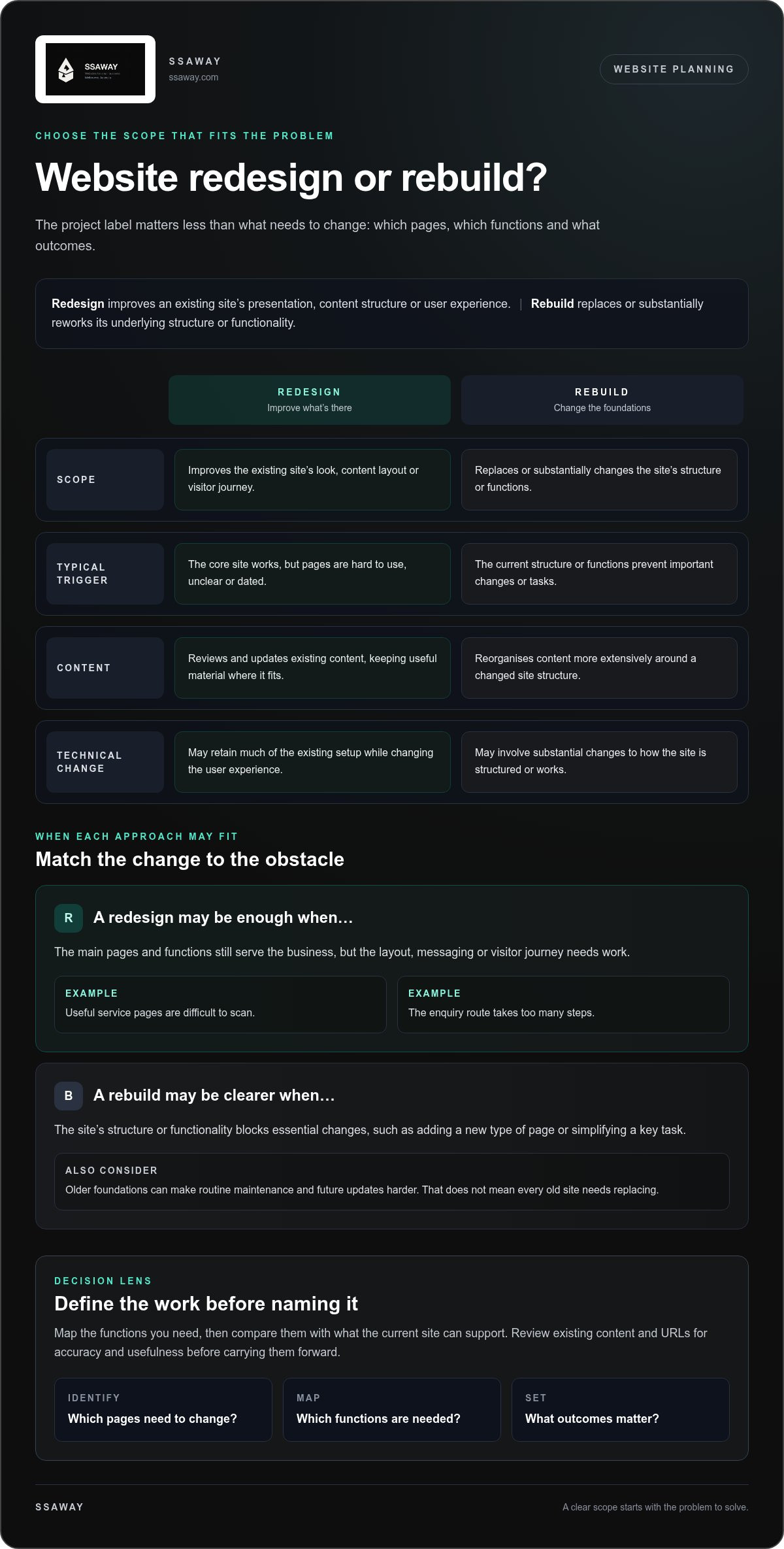
“Redesign” and “rebuild” are often used interchangeably, but they can describe different amounts of work. A redesign improves an existing website’s presentation, content structure or user experience. A rebuild replaces or substantially reworks the site’s underlying structure or functionality.
Labels vary between projects. Focus on what needs to change: which pages, which functions and what outcomes? This makes it easier to compare website redesign services australia businesses may consider without relying on a project name alone. A successful website redesign starts with a clear scope, not a label.
| Area | Redesign | Rebuild |
|---|---|---|
| Scope | Improves the existing site’s look, content layout or visitor journey. | Replaces or substantially changes the site’s structure or functions. |
| Typical trigger | The core site works, but pages are hard to use, unclear or dated. | Current structure or functions prevent important changes or tasks. |
| Content | Reviews and updates existing content, keeping useful material where it fits. | Reorganises content more extensively around a changed site structure. |
| Technical change | May retain much of the existing setup while changing the user experience. | May involve substantial changes to how the site is structured or works. |
When can an existing website be redesigned without starting again?
A redesign may fit when the main pages and functions still serve the business, but the layout, messaging or visitor journey needs work. For example, service pages may be useful but difficult to scan, or the enquiry route may take too many steps. Existing content and URLs can help shape the scope, but review each one for accuracy and usefulness before carrying it forward. The right choice depends on the site’s current structure and the changes required.
When might a website rebuild be the clearer option?
A rebuild may make more sense when the site’s structure or functionality blocks essential changes, such as adding a new type of page or simplifying a key task. Older foundations can also make routine maintenance and future updates harder. That doesn’t mean every old site needs replacing. Map the functions you need, then compare them with what the current site can support. If the gap is substantial, custom web development may be a practical route. SSAWAY’s website design and SEO optimisation can bring both considerations into the project.
The simplest test is scope. If the existing structure can support the outcome, improve it. If it can’t, plan for a rebuild. State the required pages, functions and user outcomes clearly before settling on either approach.
How can a redesign protect SEO and existing website value?
A redesign can’t guarantee that search rankings will stay unchanged. Search results can shift for many reasons. Careful planning can, however, reduce avoidable risks and help preserve the pages, content and visitor pathways that already work.
Deleting a page or changing its URL without a plan can leave visitors facing a dead end and make it harder for search engines to understand where useful content has gone. Every changed high-value URL needs an intentional destination. That destination should match the old page’s purpose as closely as possible, not send every visitor to the homepage.
What should you record before changing the website?
Build a clear picture of the current site before edits begin. Use Google Search Console and available analytics to identify priority URLs, organic landing pages, search queries and conversion actions, such as completed enquiry forms. Treat the data as evidence, not a final verdict. A page with low traffic may still contain information visitors need, so review it with an understanding of the business and its customers.
Create a content inventory and mark each page to retain, improve, combine or remove. Note its current URL, purpose and any search or business value. This gives the project a practical record to work from and helps prevent useful content from disappearing by accident.
What needs checking before and after launch?
Use this sequence to manage the transition:
- Record a baseline. Capture current organic performance, priority pages and enquiry activity.
- Inventory URLs. List existing pages and decide which content stays, changes, combines or goes.
- Map changes. Match each changed URL to the most relevant page in the updated site.
- Set redirects. Redirect retired URLs to their mapped destinations so old links still lead somewhere useful.
- Test before launch. Check navigation, forms, mobile layouts, page content and whether key pages can be found and indexed.
- Monitor after launch. Review Search Console coverage, organic traffic and enquiry paths, then investigate unexpected drops or broken journeys.
Don’t treat launch as the finish line. Compare the new site with your baseline and check that important pages still serve their purpose. If traffic or enquiries change, investigate the affected pages and paths rather than assuming the whole redesign is at fault.
For businesses considering website redesign services australia, planning design and SEO together helps keep content, URLs and user journeys in view from the start. The aim isn’t to freeze the site as it is. It’s to improve it without casually discarding the value it has built.
Planning a Website Redesign: From Brief to Launch
A clear plan keeps a redesign focused on what visitors and the business need. Set the goals first, then work through audience needs, content, design, build and launch. Prioritise tasks by customer impact, business value and risk. A fresh colour palette may be welcome, but fixing a hard-to-find service or a broken enquiry path should come first.
What should go into a useful redesign brief?
Give the brief enough detail to guide decisions without prescribing every design choice. Describe your priority audiences, core business goals, important pages and the actions visitors should take. Record what works on the current site, what causes problems and what must be retained, such as useful content, established URLs or key functions.
Prepare accurate service information, contact details, calls to action and existing site assets. Flag anything that needs updating, checking or replacing. Set success measures you can review after launch, such as relevant enquiries or completed purchase actions. Website redesign services australia businesses consider are easier to scope when the brief explains the outcome, not just the desired look.
Use the brief to guide each project stage:
- Goals and audience: agree what the site must do and who it needs to help.
- Content: organise pages and prepare accurate copy and assets.
- Design: shape layouts and calls to action around visitor needs.
- Build and review: check the working site against the agreed goals.
- Launch: complete checks, publish changes and monitor results.
What should you review before the redesigned site goes live?
Test the site as a visitor, not just as the person who helped build it. Read page content for accuracy. Check links, forms, page titles and how images display. View key pages on mobile, then follow important journeys from a search landing page or homepage through to an enquiry or purchase action. Fix unclear steps and errors before launch.
Make sure the launch plan includes a backup of the existing site, any required redirects and analytics tracking. These checks help preserve useful pathways and make it possible to assess what happens after the changes go live.
A launch-ready website is useful, functional, mobile-friendly and tested. Keep that checklist visible during final review. With SSAWAY, website design and SEO optimisation are considered together, and clients can review and approve the finished website before payment. Plan your website redesign with SSAWAY.
What should you expect from website redesign services with SSAWAY?
A useful redesign starts with the problem you want to solve, not a fixed template. SSAWAY brings website design and SEO optimisation together, so the site’s structure, content and search foundations can be considered as part of the same project. The work can be shaped around a one-page, shopfront, e-commerce or custom website need.
That matters because a small business site and an online shop have different jobs. A one-page website may need to make key information and contact options easy to find. A shopfront or e-commerce website may need clearer ways to browse products and take the next step. The project should reflect the pages and functions your visitors actually need.
How does SSAWAY keep the website project straightforward?
There’s no upfront payment required. You can review and approve the finished website before payment. That gives you the chance to assess the completed work against the goals and information set out for the project, rather than relying on a promise about what the finished site might look like.
To make that review useful, be clear about your priorities from the outset. Identify the site’s main purpose, the pages that matter most and the actions visitors should be able to take. Design and SEO can then be considered together, with usability and search visibility kept in view as the website takes shape.
What is a sensible next step for your redesign?
Write down the biggest problem with your current site and the outcome you want instead. For example, you might need visitors to find service information more easily, use the site comfortably on mobile or reach an enquiry form without confusion. Keep the goal practical and specific.
Gather the key page links, existing content and any available performance information, such as analytics or Search Console data. These give the project a useful starting point and help show what should be kept, improved or reconsidered. You don’t need a perfect brief. A clear problem and a few useful details are enough to start a focused conversation.
If you’re comparing website redesign services australia businesses can use, focus on how the process connects your goals, design and search needs, and how you’ll review the finished website. Explore SSAWAY website design services.
Make your next website decision with confidence
A website doesn’t need a full overhaul just because it looks dated. First identify what isn’t working, then decide whether targeted improvements, a redesign or a rebuild best fits the problem. Set clear goals, review useful content and URLs, and plan SEO checks before changes go live. A careful process can reduce avoidable disruption, though no redesign can guarantee unchanged search rankings.
If you’re considering website redesign services australia businesses can use, look for an approach that connects design decisions with visitor needs and search foundations. SSAWAY offers website design and SEO optimisation together. Projects are priced under A$1,000, with no upfront payment required, and clients can review and approve the finished website before payment.
Start with the outcome you want from your site, then explore SSAWAY website design services.
Frequently Asked Questions
What are website redesign services?
Website redesign services improve an existing site’s appearance, structure, content presentation or usability to better support visitors and business goals. The work might focus on a few key pages or involve broader changes across the site. Start by identifying what isn’t working and what needs to improve. If URLs or page structures will change, plan technical and SEO checks too, so useful pages and visitor pathways aren’t overlooked.
When should an Australian business redesign its website?
Consider a redesign if your website is hard to use on mobile, confusing to navigate, out of date or no longer reflects the business. Check available analytics and enquiry data before deciding. One page with weak results may need a targeted improvement, not a whole-site overhaul. Broader work may be justified when problems affect several pages or user journeys. Let evidence, business priorities and the current site’s structure guide the scope.
Can a website redesign affect Google rankings?
Yes. Changes to URLs, page content, internal links or indexability can affect how search engines understand a site, and a redesign can’t guarantee unchanged rankings. Reduce avoidable risks by recording current performance, reviewing valuable pages, mapping changed URLs to relevant destinations and setting appropriate redirects. Before launch, check that important pages can be found and indexed. After publishing, monitor Google Search Console and relevant analytics for issues.
What is the difference between a website redesign and a rebuild?
A redesign generally improves an existing website’s presentation, content structure or visitor experience. A rebuild replaces or substantially changes the site’s underlying structure or functionality. The terms aren’t used consistently, so focus on the work involved. If the current site’s structure supports your goals, improvements may be enough. If its limitations prevent essential changes or functions, a rebuild may be a clearer fit.
How long does a website redesign take?
The time required depends on the project’s scope, including the number of pages, content needs and functionality. The time it takes to prepare materials and make decisions can also affect progress. A focused update and a substantial rebuild are different projects, so agree on the scope, review responsibilities and key stages before work begins.
What should I prepare before redesigning my website?
Start by defining the website’s goals, priority audiences and the actions visitors should take. Gather links to current pages, accurate business information, existing content and any available performance data. Note which pages or functions must stay and what problems need solving. This gives the project a clear starting point and helps you review the finished site against practical requirements, rather than relying only on whether the new design looks different.
Will I need to rewrite all my website content during a redesign?
No, you don’t necessarily need to rewrite every page. Review each one for accuracy, usefulness and fit with current business goals. Some content may still serve visitors well; other pages may need updating, combining or removing. Record important URLs and available search performance before changing content. The aim is to keep what remains useful while making information clearer and more current, not to preserve every page exactly as it is.
How much do website redesign services cost in Australia?
The price depends on the project scope, including the number of pages, design changes, content needs and functionality. Compare what’s included and how you’ll review the finished website, rather than looking at a headline price alone. SSAWAY uses fixed pricing for website design and development, with projects priced under A$1,000. No upfront payment is required, and clients can review and approve the finished website before payment.


