
What if the option that looks cheaper today costs more once your website is up and selling? A Shopify subscription may be easier to budget for, while a fixed-price build can look like a one-off expense. But neither headline tells you the full cost of running a site. The shopify monthly fees vs fixed price website comparison only makes sense when you include the costs and work that continue after launch.
It’s fair to want predictable costs and a website that suits the way your business sells. Shopify spreads platform costs over time, but plan fees, payment fees and paid apps can add up. A fixed-price website puts more of the cost into the build, but hosting, maintenance and updates may still bring ongoing expenses. The lowest starting figure isn’t always the better-value choice.
This article compares both models over three years, separating platform and transaction fees from hosting, maintenance, apps and your own time. It also explains how your sales needs and appetite for ongoing support affect the decision, and what to check before committing. With SSAWAY, there’s no upfront payment for a website project, and you review and approve the completed website before payment.
Key Takeaways
- Separate the website project fee from the ongoing costs of keeping the site running. A fixed-price build doesn’t automatically cover future hosting, maintenance or changes.
- Compare Shopify’s plan, payment method and any paid apps you actually need with the full scope and running costs of a fixed-price website.
- Choose a website model based on essential sales features and the flexibility you need, not a list of optional extras.
- Before deciding, list your needs, map recurring costs, compare project scope and work out who will handle ongoing tasks.
- Explore SSAWAY’s one-page, shopfront, e-commerce and custom development options, with no upfront payment and approval of the completed website before payment.
Shopify monthly fees vs a fixed-price website: what are you comparing?
These are two different ways to pay for a website. Shopify charges a recurring subscription for access to its hosted commerce platform. A fixed-price website is a project with an agreed scope and fee for defined work. One spreads platform costs over time; the other sets a price for building the agreed website. Neither figure, by itself, shows the full cost of operating a business website.
So don’t compare a monthly subscription directly with a project quote. Look at what each option delivers, when you pay, which costs recur and who is responsible for ongoing tasks. A modest subscription can grow as you add services or tools. A defined build fee can be followed by operating expenses.
What does a fixed-price website mean?
A fixed-price website has an agreed project price for a defined scope of design and development. The scope should spell out the pages, features and SEO work included. It doesn’t automatically cover every expense after the build. Domain registration, hosting, maintenance, content updates or third-party services may be separate, depending on the project arrangements.
Think of the project fee as the cost of the agreed work, not a promise that the website will have no future running costs. A simple site and an online shop also have different requirements. The more specific the scope, the easier it is to compare what you’re paying for.
What does Shopify’s monthly subscription cover?
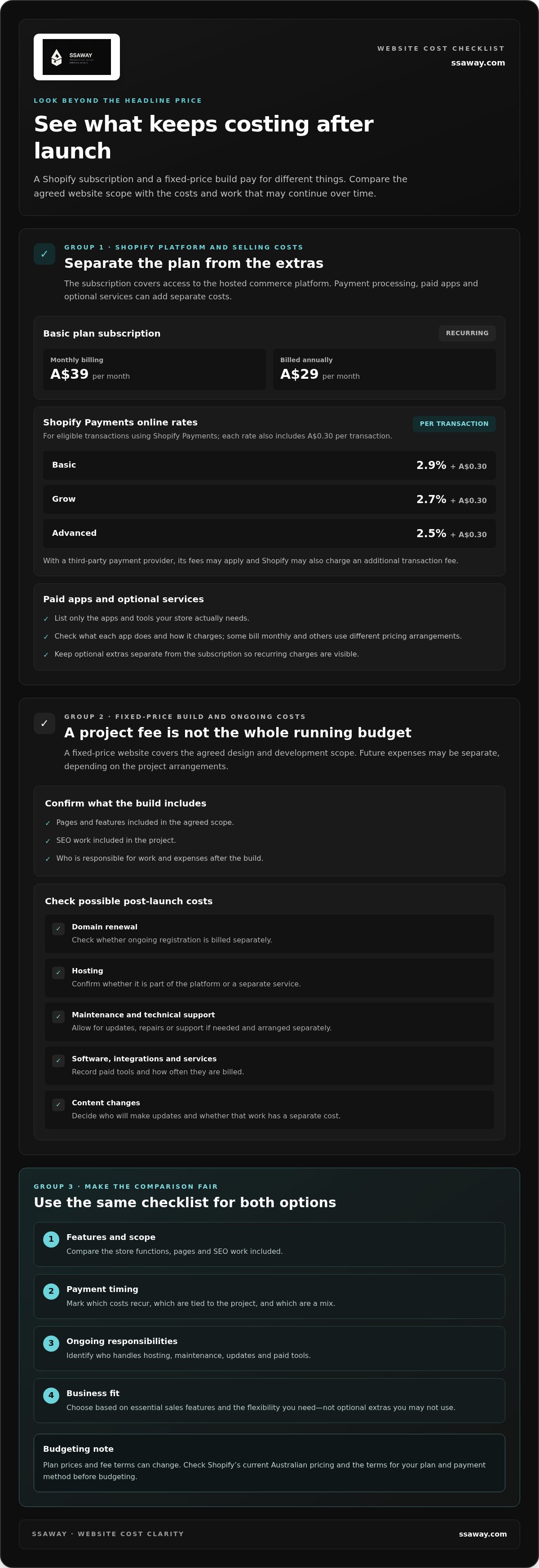
Shopify is a hosted commerce platform with tiered subscriptions and built-in store features. Its business model centres on providing tools for businesses to run online stores. Plan features and terms vary, so check Shopify’s official Australian pricing before deciding. As at October 2026, the Basic plan is A$39 per month, or A$29 per month when billed annually. That covers the platform subscription, not necessarily the full cost of selling online.
Separate the subscription from other budget lines. Payment processing depends on your payment setup, while paid apps and optional services can add recurring charges. Some businesses need only the features in their chosen plan; others pay for extra tools to meet specific requirements.
For a fair comparison, put both options on the same footing. Check:
- Features: Which store functions, pages and SEO work are included?
- Payment timing: Is the cost recurring, tied to a project, or a mix?
- Ongoing responsibilities: Who handles hosting, maintenance, updates and paid tools?
- Business fit: Does the setup suit the way you plan to sell and manage the site?
Once you have these details, you can compare the actual scope and ongoing commitments rather than two headline figures that describe different things.
Which Shopify costs can sit beyond the monthly subscription?
The subscription is only one line in a Shopify budget. Payment processing, paid apps and optional services can change the total, and not every store needs every extra. Costs depend on your plan, payment setup and the tools your business uses. List each expense separately so you can see which costs are essential and which are optional.
How payment and app fees affect the comparison
Payment processing is separate from the monthly plan. As at October 2026, Shopify Payments online rates are 2.9% plus A$0.30 per transaction on Basic, 2.7% plus A$0.30 on Grow, and 2.5% plus A$0.30 on Advanced. These rates apply to eligible transactions using Shopify Payments. If you use a third-party payment provider, that provider’s fees may apply, and Shopify may also charge an additional transaction fee. Check the current Australian terms for your plan and payment method before budgeting.
Apps are another separate cost. A store might add a paid app for a function it needs, but an app isn’t necessary just because it’s available. Some apps charge monthly, while others use different pricing arrangements. Review what each app does, how it charges and whether your store needs that feature. Several small subscriptions can become a significant recurring expense.
Shopify plan prices and fee terms can change. Use Shopify’s official Australian pricing information for current figures rather than relying on old search results or a fee quoted for another country. Record when you checked, which plan you considered, the payment option and any transaction charges. That gives you a more reliable basis for comparing the shopify monthly fees vs fixed price website over time.
Which ongoing website costs should you budget for?
A fixed project fee covers the agreed build, not necessarily every cost after launch. Separate possible running expenses from the project fee, and identify which apply to your setup:
- Domain renewal: Budget for ongoing registration if the domain is billed separately.
- Hosting: Check whether hosting is part of the platform or a separate service.
- Maintenance: Allow for updates, repairs or technical support if needed and arranged separately.
- Software and services: List paid apps, integrations or other tools, including how often they’re billed.
- Content changes: Decide who will make updates and whether that work has a separate cost.
Inclusions differ by platform and project scope. Don’t assume hosting, security, maintenance or future changes are bundled into a quote. Get a written list of recurring obligations, who manages each one and when charges are due. This makes it easier to compare like with like, without treating every optional expense as compulsory.
For a project-based alternative, explore SSAWAY’s e-commerce website options and decide which store functions should be included in the project scope.
Shopify vs a fixed-price website: compare total cost and control
The right choice depends on more than the first payment. Compare what your business needs to sell, what work is included and who will manage the site after launch. Shopify brings store functions together within its platform. A fixed-price project defines the website work upfront, with flexibility shaped by the agreed scope. Neither model automatically means lower costs or more control.
| What to compare | Shopify | Fixed-price website |
|---|---|---|
| Payment model | Recurring subscription, with possible separate processing, app or service charges. | Agreed fee for the defined project scope, with possible ongoing expenses after launch. |
| Initial commitment | Subscription plan, billed according to the selected payment option. | Project agreement sets out the work and payment terms. Payment timing varies by arrangement. |
| Recurring costs | Plan fees continue, while payment and optional tool costs depend on use. | May include separate domain, hosting, maintenance, updates or third-party services. |
| Feature scope | Features depend on the selected plan and tools used. | Pages, selling functions and other deliverables are defined by the project scope. |
Use the table as a starting point, not a verdict. Check the agreement for responsibilities around hosting, maintenance, site changes and data or content portability. Ownership and the ability to move a site to another setup depend on platform terms and the project contract. Don’t assume either model gives you more control without checking what the arrangement covers.
Where Shopify can make sense for an online store
Shopify may suit a business that wants its commerce tools and store management within a subscription platform. Different plan features serve different store requirements, so compare current Australian inclusions with your must-haves. If the built-in tools fit and reduce the work of managing separate services, recurring fees may be a reasonable trade-off. The value comes from using what the plan provides, not paying for features you don’t need.
Where a fixed-price website can make sense
A fixed-price project may suit a business that prefers a defined build to an ongoing platform-plan payment. The scope can be shaped around the required pages and selling functions, from a straightforward shopfront to e-commerce needs. Start by listing those requirements, then account for ongoing responsibilities separately. If you’re weighing up store scope, explore e-commerce website packages in Australia.
For example, a business that needs a focused product catalogue and checkout should compare those specific functions with the project scope. It shouldn’t assume it needs every available app or platform feature. Better value comes from meeting the sales need without creating avoidable costs or workload. Include the time your team will spend managing the site when you compare the full commitment.
How to decide which website payment model fits your business
Base the decision on your actual needs, not a plan headline or project fee in isolation. The shopify monthly fees vs fixed price website comparison is useful when you measure both options against the same features, time period and workload.
Match the website model to your sales needs
Start with what the site must do. Do you need a simple business presence, a product catalogue, online checkout or a mix? Write down essential functions such as product listings, payment processing and any store tools your business genuinely needs. Then compare that list with features in Shopify’s current Australian plans. Don’t pay for a plan or app feature just because it’s available.
Your project scope should match the way you sell, too. A brochure-style site and a full online store have different requirements. For more context on Australian website design cost factors, consider how the pages, features and work required shape a website project. You can also explore affordable website design for Australian small businesses when considering broader options.
Build a fair long-term comparison
Use the same period for both options, such as three years, and enter current, verified figures. Keep the project fee separate from recurring charges. Add likely payment processing and paid tools based on your expected use, rather than assuming every possible fee applies.
- List your needs. Separate must-have pages and selling functions from optional features. Note what customers need to do on the site.
- Map recurring costs. Record platform subscriptions, payment processing, domain renewal, hosting, apps and other services as separate lines. Use current Australian pricing and note when you checked it.
- Compare scope. Match the required pages, store functions and SEO work against the project deliverables or features in the chosen Shopify plan. Mark anything that would need extra work or tools.
- Check responsibilities. Write down who manages content, updates, store operations, maintenance and renewals. Include the time your team will spend on those tasks.
Copy this blank worksheet for each option. Use A$ for monetary entries and leave a line blank if it doesn’t apply. Verify unknown items before including them in the total.
- Comparison period: ______
- Project fee or platform subscription: ______
- Payment processing and paid tools: ______
- Domain, hosting and other services: ______
- Maintenance, updates and content work: ______
- Who manages each task: ______
- Estimated total for the period: ______
The figures matter, but so does the workload. A platform subscription may suit you if its tools fit and simplify store management. A defined project may suit you if its scope matches your needs and you prefer that payment model. Explore a website project for your business. SSAWAY requires no upfront payment, and you approve the completed website before paying.
A fixed-price website with SSAWAY: clear scope, payment after approval
A website project offers a different payment model from an ongoing Shopify plan. SSAWAY offers one-page, shopfront and e-commerce website packages, as well as custom web development for tailored projects. The right fit depends on what your site needs to do, from presenting core business information to supporting online sales.
There’s no upfront payment, and you review and approve the completed website before paying. That lets you assess the finished work before payment. The project scope still matters: it defines what is being built and helps set expectations on both sides.
What the SSAWAY project model changes
Instead of paying a continuing Shopify platform subscription, you engage SSAWAY for a defined website project. There’s no upfront payment, and payment follows your review and approval of the completed website. SSAWAY website design packages include SEO optimisation, but this doesn’t mean guaranteed search rankings or sales. Hosting, maintenance, ownership and technical arrangements depend on the project details, so don’t assume they’re automatically included.
This model may suit you if your main concern is committing to ongoing platform fees before you know whether the included tools meet your needs. It doesn’t remove every possible future website expense. The build is treated as a project, with the work and expectations shaped by the agreed scope.
Choose the right next step for your website
Start with the site’s purpose. A one-page website may suit a focused business presence; a shopfront may be a better match for presenting products or services; an e-commerce website is relevant when customers need to buy online. Custom development is an option for requirements that call for a tailored build. List your essential pages and functions before choosing a format.
If online selling is central to your business, use this e-commerce website package guidance to think through the store features you need. Then compare the project scope with Shopify’s current plan features and any ongoing costs that apply to your setup. This is more useful than choosing a model based only on its first visible charge.
The shopify monthly fees vs fixed price website decision comes down to fit, responsibilities and payment preferences. SSAWAY’s approval-before-payment process means you don’t pay upfront for the completed website, while a clear project scope helps define the work. Review the website options and choose a path that matches your business needs.
Explore SSAWAY website options and take the next step towards a website project that fits your business.
Choose a website model that fits your next step
Your website should support the way you want customers to find, understand and buy from your business. Before committing, decide what it needs to do now and which features are essential. That gives you a clearer basis for weighing the shopify monthly fees vs fixed price website choice, without paying for a setup that doesn’t match your plans.
If a defined project feels like the better fit, SSAWAY offers one-page, shopfront and e-commerce website packages. There’s no upfront payment, and you can review and approve the completed website before paying. This approval step gives you the chance to assess the finished work before payment and can make starting a website project feel more manageable.
Take the next step with a clear idea of your site’s purpose and the features your customers need. Explore SSAWAY’s fixed-price website options and find a project direction that suits your business. Start with what your customers need now, then make future website decisions as your needs develop.
Frequently Asked Questions
How much does Shopify cost per month in Australia in 2026?
Shopify’s Australian plan prices range from A$5 per month for Starter to A$399 per month for Advanced when billed monthly. Basic is A$39 monthly, or A$29 per month with annual billing; Grow is A$105 monthly, or A$79 with annual billing. Shopify Plus starts at A$2,300 per month on a three-year term. Check Shopify’s Australian pricing page before signing up, as plan terms can change.
Are Shopify monthly fees the only ongoing costs for an online store?
No. Your total can also include payment processing, paid apps and optional services. One store might pay for an app to add a needed function, while another may not need that tool. Some costs depend on sales volume or payment setup, so estimate them using your expected order numbers and actual tools rather than adding every possible fee to your budget.
Is a fixed-price website really free of monthly costs?
Not necessarily. A fixed project price covers the agreed work, but ongoing expenses may still apply for a domain, hosting, maintenance or third-party services. For example, a business might need to renew its domain each year or arrange separate help for future updates. Before treating the build as your full website budget, identify the recurring tasks and services your setup requires.
Can I use my own domain name with Shopify?
Yes, you can connect a domain you already own to your Shopify store or arrange a domain through Shopify. Keep track of where the domain is registered, who controls its account and when renewal is due. If you later change platforms, domain access and the website itself are separate matters, so retain your registrar login and review the relevant transfer steps.
What happens to my Shopify store if I cancel my subscription?
Canceling a subscription can stop access to paid store features and prevent customers from using online checkout. The exact effects depend on Shopify’s current cancellation terms and your account status. Before cancelling, review those terms, save copies of important store information and check how connected apps, your domain and any outstanding charges will be handled. Don’t assume the store will remain available in its current form.
Do Shopify payment processing fees apply on top of the plan?
Yes. Payment processing is separate from the subscription. As at October 2026, Shopify Payments online rates are 2.9% plus A$0.30 per transaction on Basic, 2.7% plus A$0.30 on Grow and 2.5% plus A$0.30 on Advanced. Using a third-party payment provider may also trigger an additional Shopify transaction fee, alongside the provider’s own charges. Check current Australian rates for your plan.
Can a fixed-price website include e-commerce features?
Yes. A fixed-price website project can include e-commerce functionality when it’s part of the agreed scope. For example, a business may need product pages and online checkout rather than a site that only presents contact details. The specific functions depend on the project requirements. SSAWAY offers e-commerce website packages, giving businesses a project-based option to consider alongside a Shopify subscription.